Blog / place stories
Stories of places nearby and Budějovice legends — a few minutes of reading and you will walk past the same things differently.
What interests you and what would you like to read?
Place stories
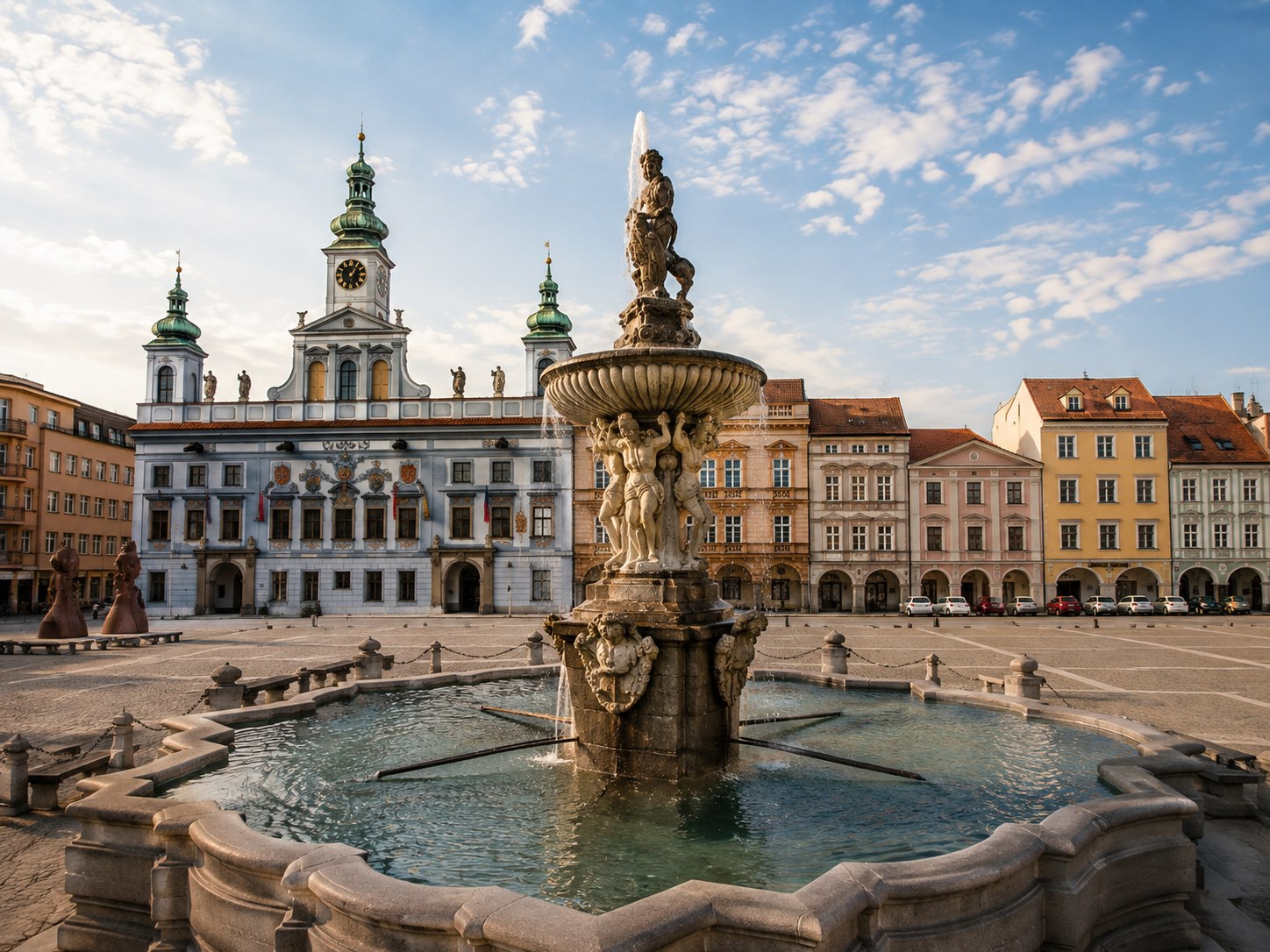
Přemysl Otakar II Square
The square forms an almost perfect 133×133 metre square, edged with 14th-century arcades. Legend says an execution block once stood here — and that anyone who steps over the Wandering Stone at a certain hour will lose their way.
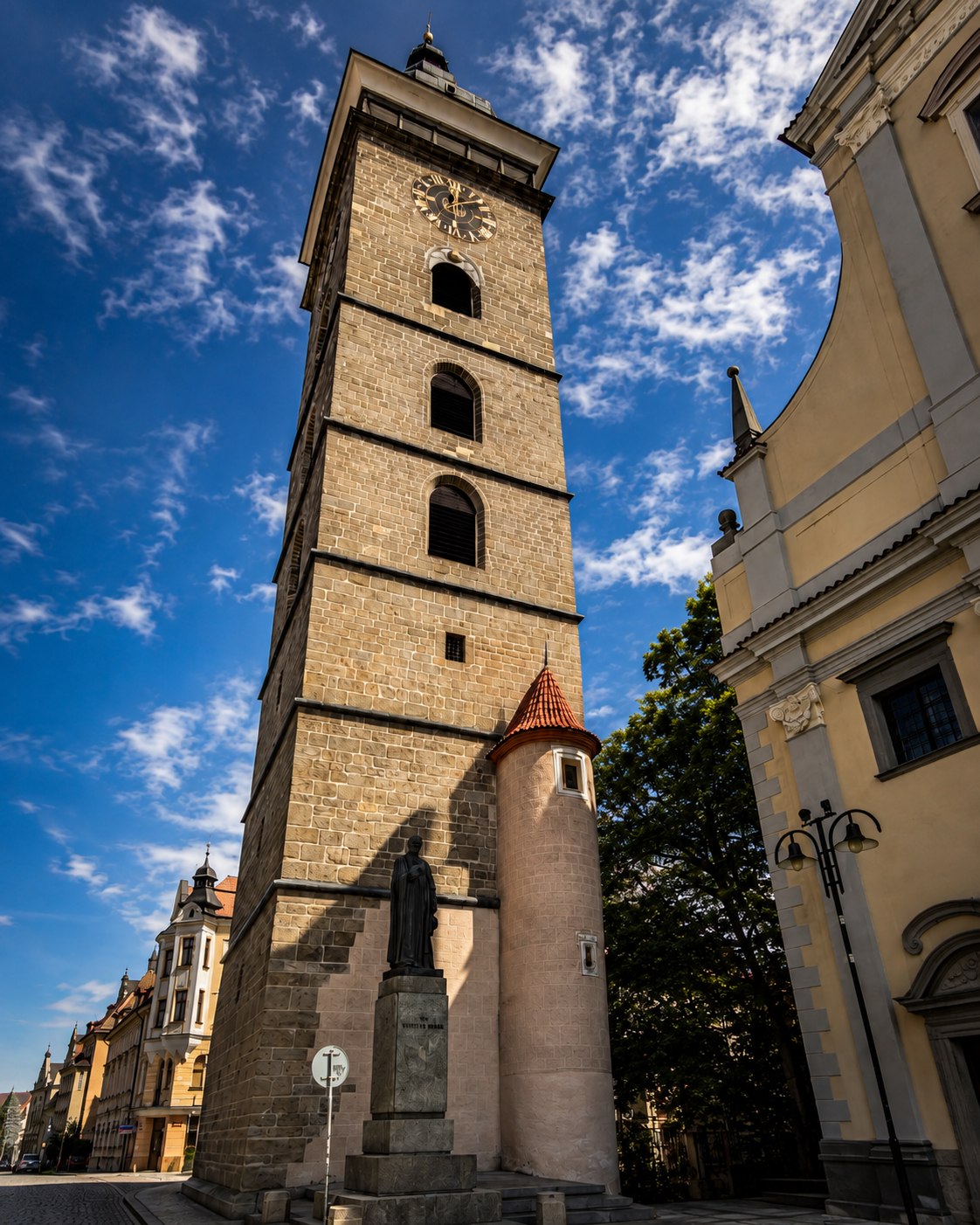
Black Tower
A belfry and watchtower from 1549–1577, over 72 metres high — 225 steps lead to the viewing gallery at 46 metres. It only got its name around 1890, when the stone blackened more from industrial soot than from fire, as tradition claims.
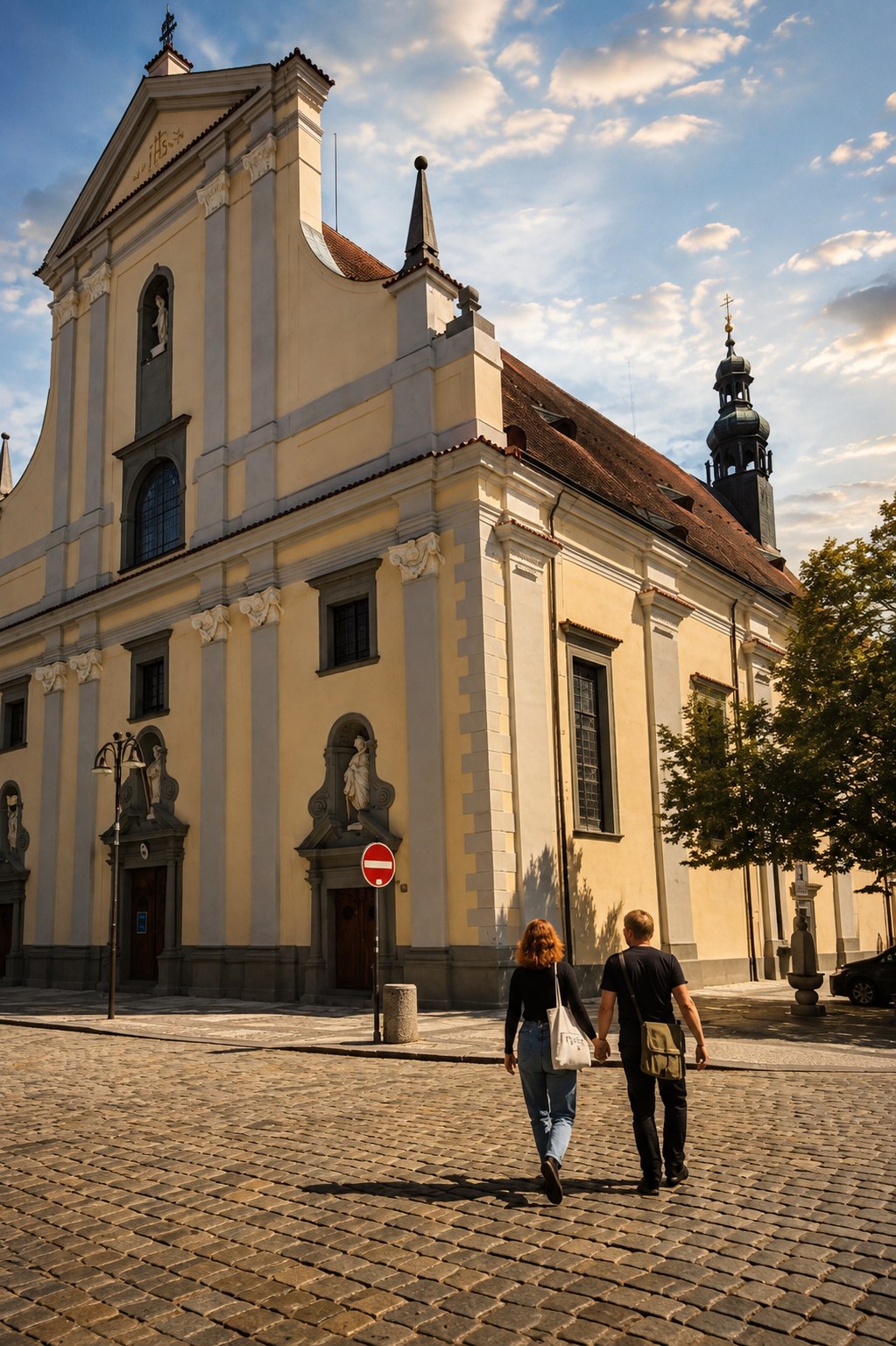
Cathedral of St Nicholas
A parish church from 1265, rebuilt after the devastating 1641 fire by Italian builders into Baroque form. The remains of the town’s patron, Saint Auracian, arrived here from the Roman catacombs in 1644 — modern anthropology suggests they most likely belonged to a woman.
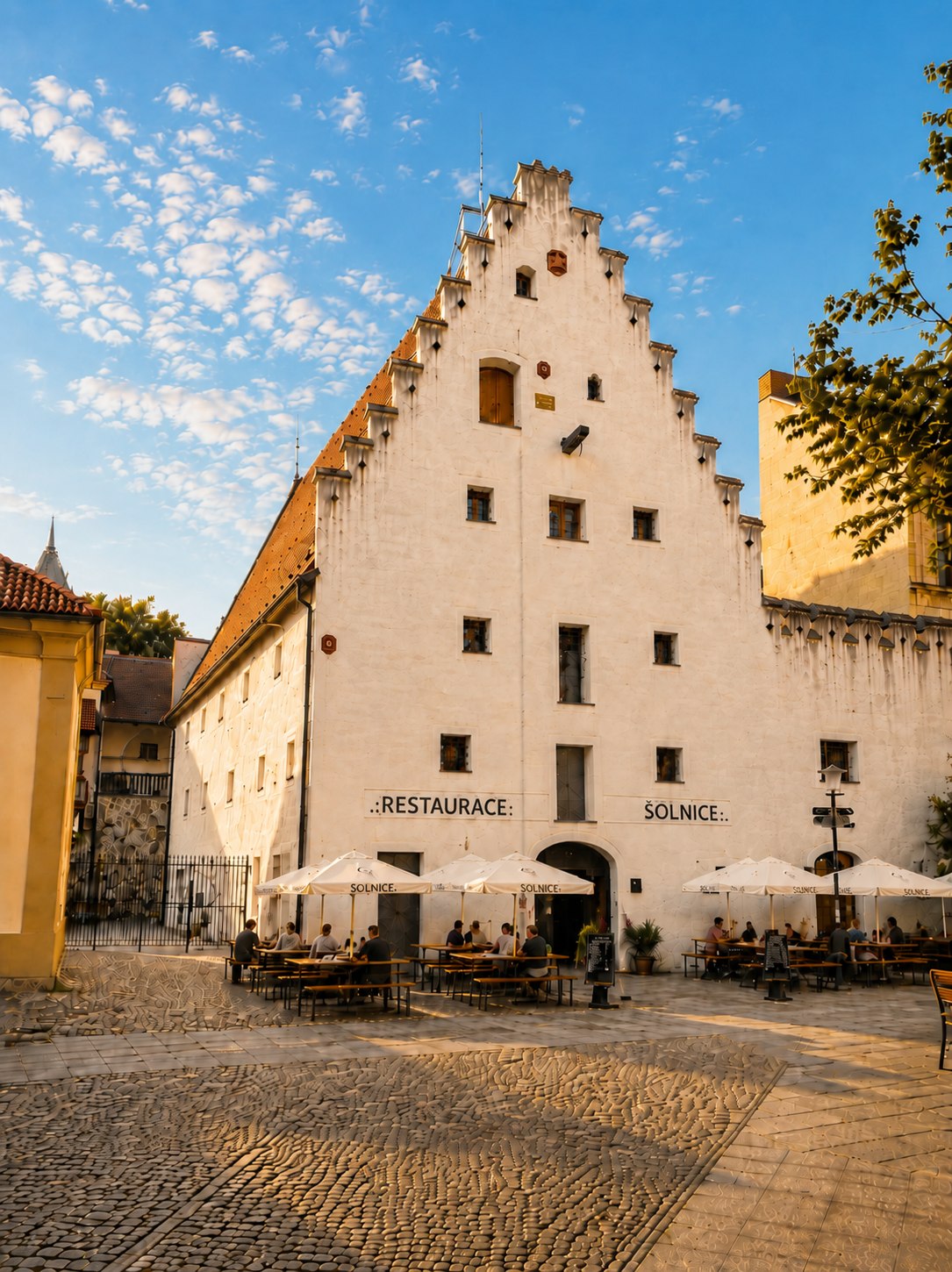
Solnice
The 1531 building takes its name from a salt store, though salt lay here only about twenty years of five hundred — for most of its history it served as a granary and armoury. Beer reaches it by pipe 70 metres under the square from…
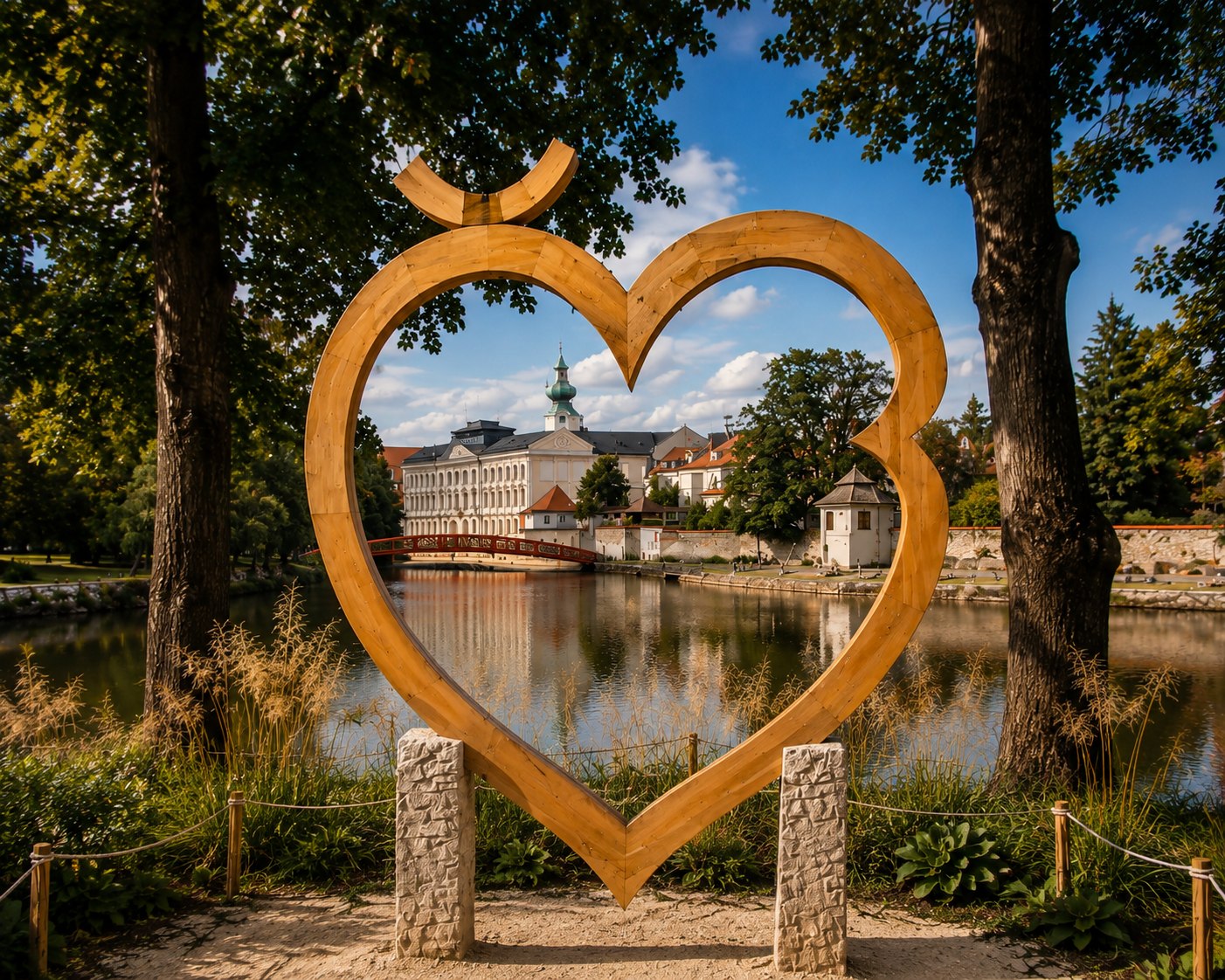
Stromovka
Budějovice’s largest park (68 hectares) was created in the 1950s by volunteer brigades — according to period press, young people planted ten thousand trees here. Lake Bagr was never in any plan: it is flooded pits from post-war gravel extraction that filled themselves with groundwater.
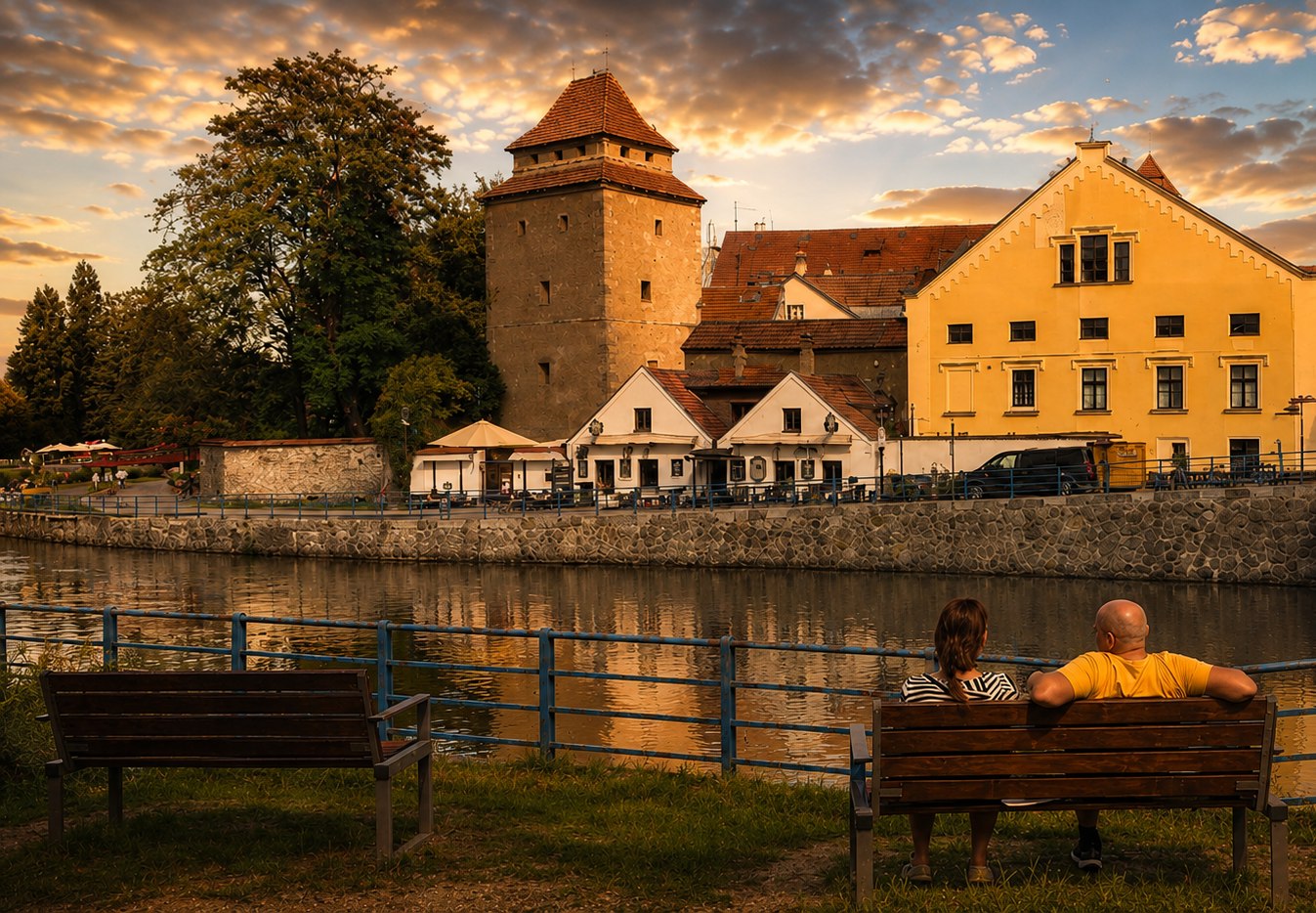
Iron Maiden
A 14th-century fortification tower was called Špilhajbl until the end of the 19th century — after a burgher who owned the neighbouring house. It was renamed Iron Maiden because that sounded more enticing; that any such torture device was ever here is not backed by a single document.
South Bohemian Museum
The museum was founded in 1877 from gifts by ordinary townspeople and today holds over 800,000 objects in its collections — of which you see only a fraction. In the moldavite case lies green glass that flew into South Bohemia from Bavaria: molten rock blasted into the stratosphere by a meteorite impact nearly fifteen million years ago.
Plachého street (Plachanda) — and Plachý Café
Budějovice’s narrowest lane, once used to drive pigs to the square because the main entrances were thought undignified for livestock. Hence the old name Svinská (Pig Lane). Today it holds Neapolitan pizza, a Danish-trained bakery, Spanish and Venezuelan cooking, and a café run by the great-grandson of the innkeeper who did hospitality in the same house a hundred and twenty years ago.
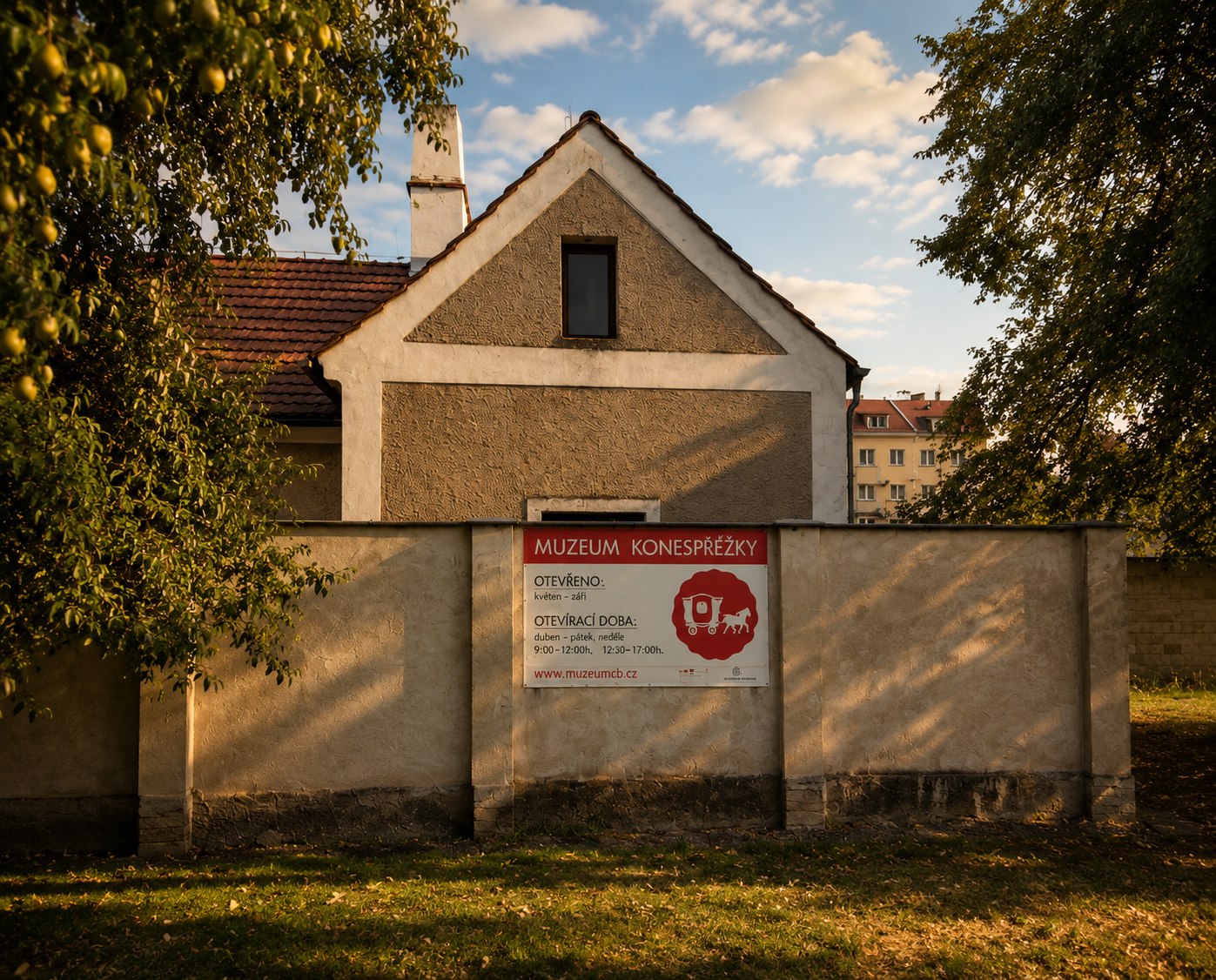
Horse-drawn railway museum
From Budějovice to Linz ran the first public railway on the European continent — and it was built against the will of almost everyone. Peasants came at the builders with axes, carters hauled freight below cost to ruin them, and finished rails vanished at village smithies.
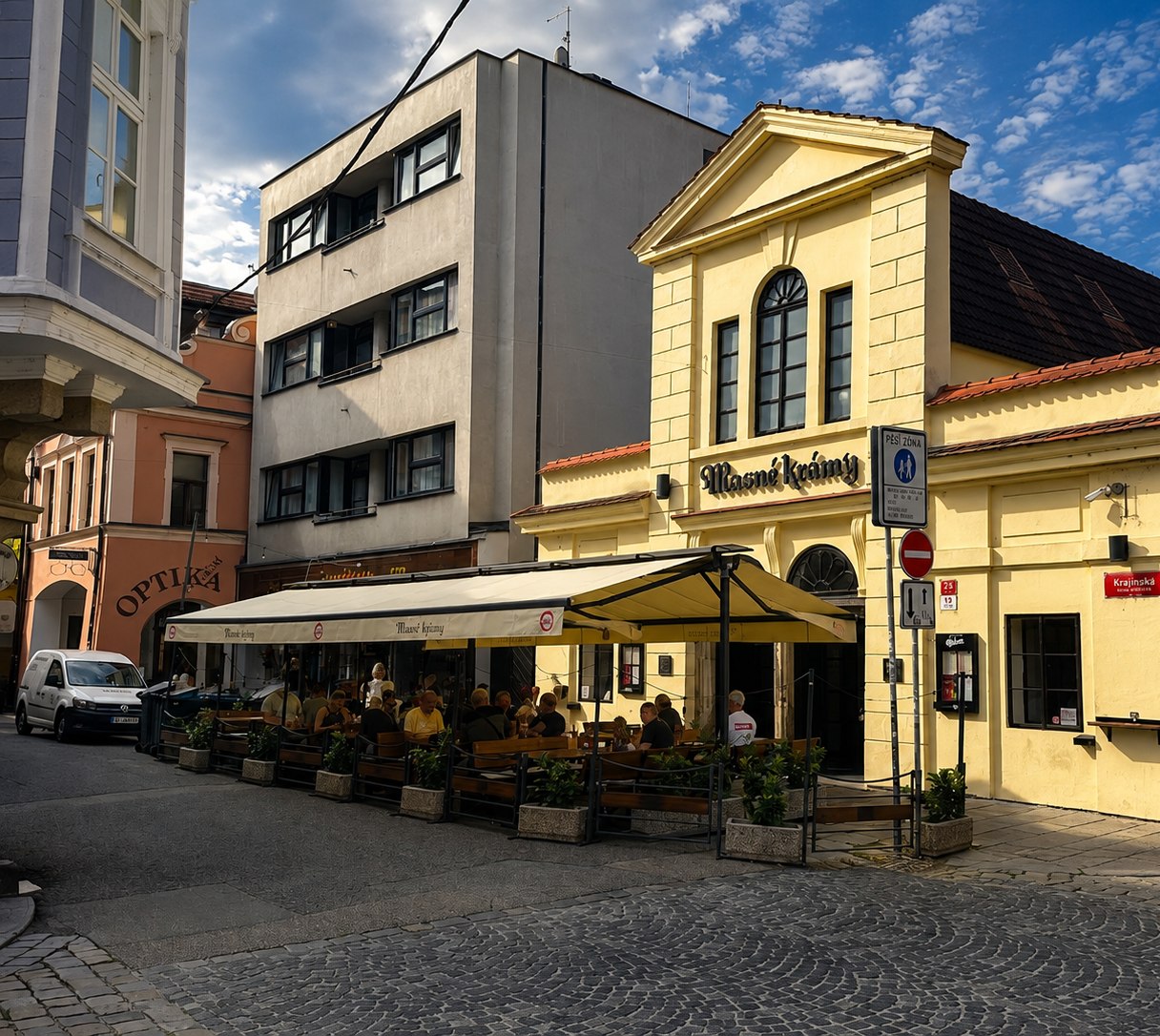
Masné krámy
Budějovice’s best-known restaurant sits in a house the town spent a hundred years trying to buy so it could demolish it. It failed because the building belonged not to one owner but to twenty-eight — and it was enough for one to refuse to sell. Today it again has twenty-eight owners.
Samson Brewery
The oldest Budějovice brewery. Beer has been brewed here since 1795 — a hundred years earlier than at Budvar — and yet for over a hundred years it was not allowed to use its own historic name. That name had meanwhile been registered by the younger one.
Budějovický Budvar
The longest trademark dispute in the world has run for over a hundred years and turns on one word: Budweiser. What is odd is that the American trademark of 1876 is nineteen years older than the brewery that defends it here.
South Bohemian Theatre and the revolving auditorium
The revolving auditorium in the Český Krumlov castle garden was the first in the world. The first sixty spectators in 1958 were turned by forty people by hand — and since 1990 there has been a dispute over whether it may stand there at all.
Water Tower
The Water Tower on the bank of the Vltava in Mánesova street looks like a castle remnant, but it is a machine for water — from 1724 it drove water into the town for Samson’s Fountain. You could not drink from it, though. For drinking water the town had from 1882 a second, completely separate pipe ending in street drinking fountains. Water was only brought into flats from the 1950s, so even the great-grandmothers of today’s Budějovice people still went outside for drinking water.
Eliáš inheritance adit (Úsilné)
The Eliáš inheritance adit in Úsilné is a three-kilometre passage under the village, begun on 20 July 1574 to drain flooded silver mines near Rudolfov. It did not save them — it was finished just as mining was already declining. Three and a half centuries later, though, drinking water ran through it into České Budějovice. The first 350 metres can be walked with a guide, by telephone appointment.
Summer swimming pool
A Functionalist complex of 1933 on Sokolský ostrov, nicknamed little Budějovice Barrandov. The fifty-metre pool was meant to be the largest in all of then Czechoslovakia — and people were already swimming in it a year before it was finished.
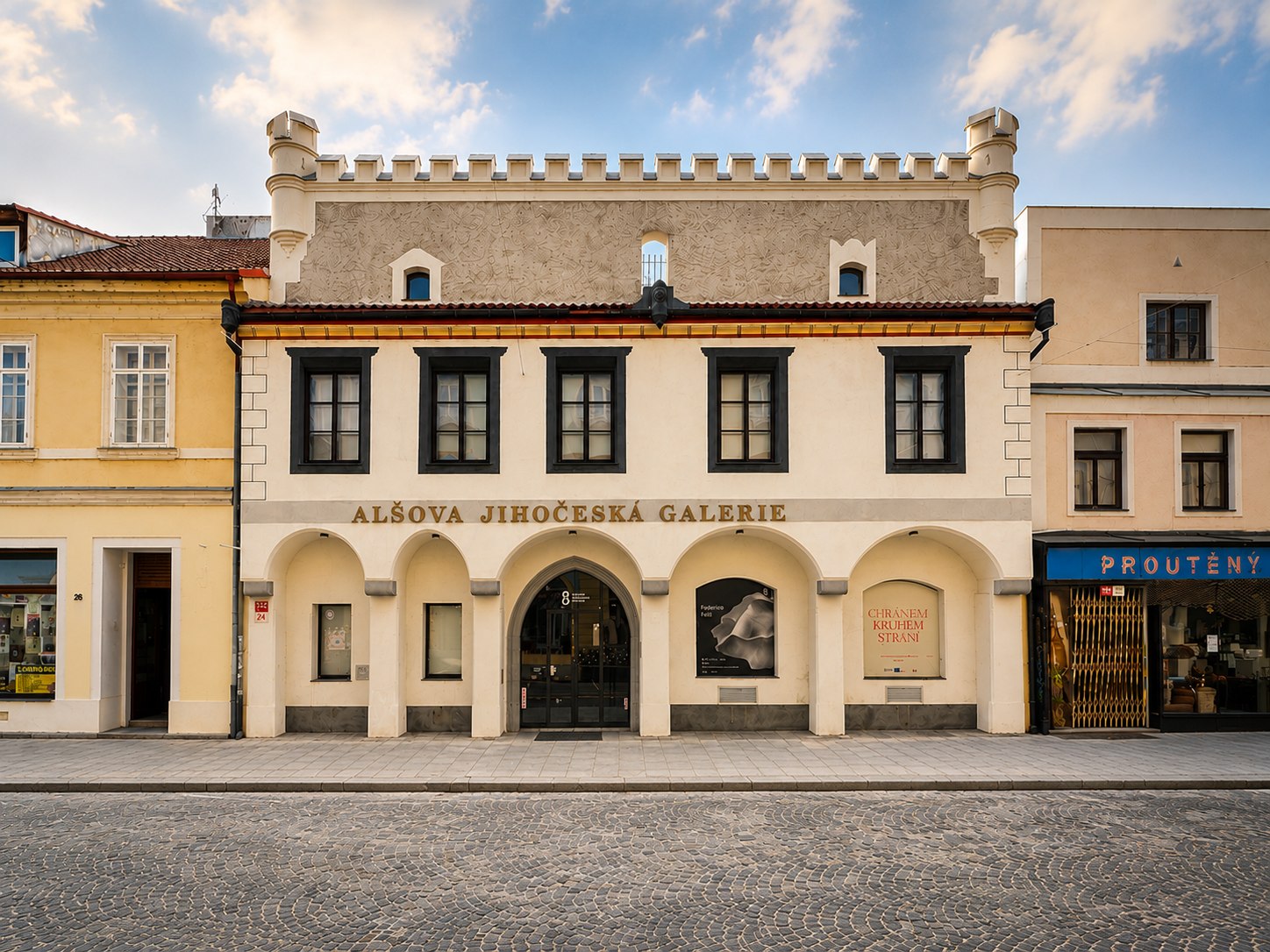
Aleš South Bohemian Gallery — Wortner House
Wortner House on U Černé věže street, with battlements and turrets, looks more like a small fortress than a burgher house. It arose in the mid-16th century by joining two cottages that until 1506 belonged to the Budějovice Jewish community — the community the town wiped out in the winter of 1505. Today it holds an exhibition hall of the Aleš South Bohemian Gallery, and inside Renaissance beam ceilings stained with bull’s blood remain.
Rudolfov — the mining town Budějovice killed and then inherited
Rudolfov today is a quiet little town ten minutes from Budějovice. In the sixteenth century it was one of the largest towns in South Bohemia: over two hundred and fifty houses, a royal mining office, its own name from the emperor, and silver carted to the Budějovice mint. It took fifty years for ruins to be left — and it was Budějovice that asked for that. Today an educational trail runs through it, and a museum sits in the house of the royal mining official.
Koh-i-noor Hardtmuth
Pencils have been made in České Budějovice since 1848, and the largest share of the firm’s production still arises here. The yellow Koh-i-noor pencil is Budějovice too — Franz Hardtmuth invented it and named it after the diamond in the English Crown Jewels at a time when he had already lived here forty years and run the factory. With it came the hardness grading that became a world standard: letters you find on every pencil on earth. What they mean is still disputed.
Dominican monastery and Piaristické náměstí
A hundred metres from the main square stands the oldest building in České Budějovice — the Dominican monastery with the Church of the Presentation of the Virgin Mary, whose building began in 1265 at the same time as the town’s founding. It is probably the very first urban building that rose here. Inside are medieval wall paintings including a figure of St Christopher over ten metres high, and the square in front of it stands on the site of a former cemetery. It is named, though, after the Piarists, who arrived five hundred years later.
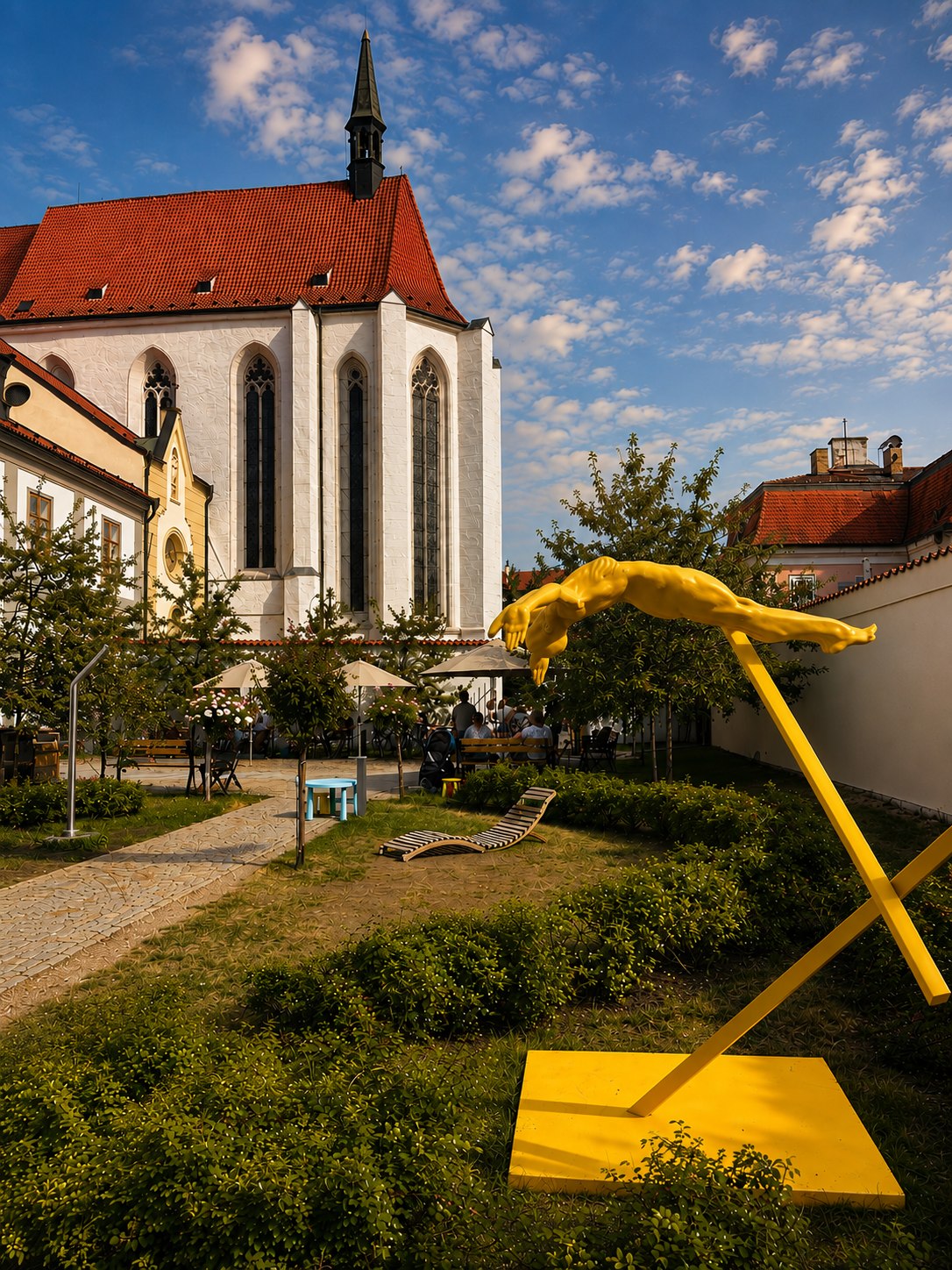
Bishop’s residence — on the way to the walls
When you walk from the square toward the walls, you pass a large sober building with a tower. It looks like an office and is one — only it was not built by those who sit in it, and neither of them paid for it. The town paid, monks built it, and a bishop moved in because the emperor decided so. The most interesting thing about it is what is missing from it.
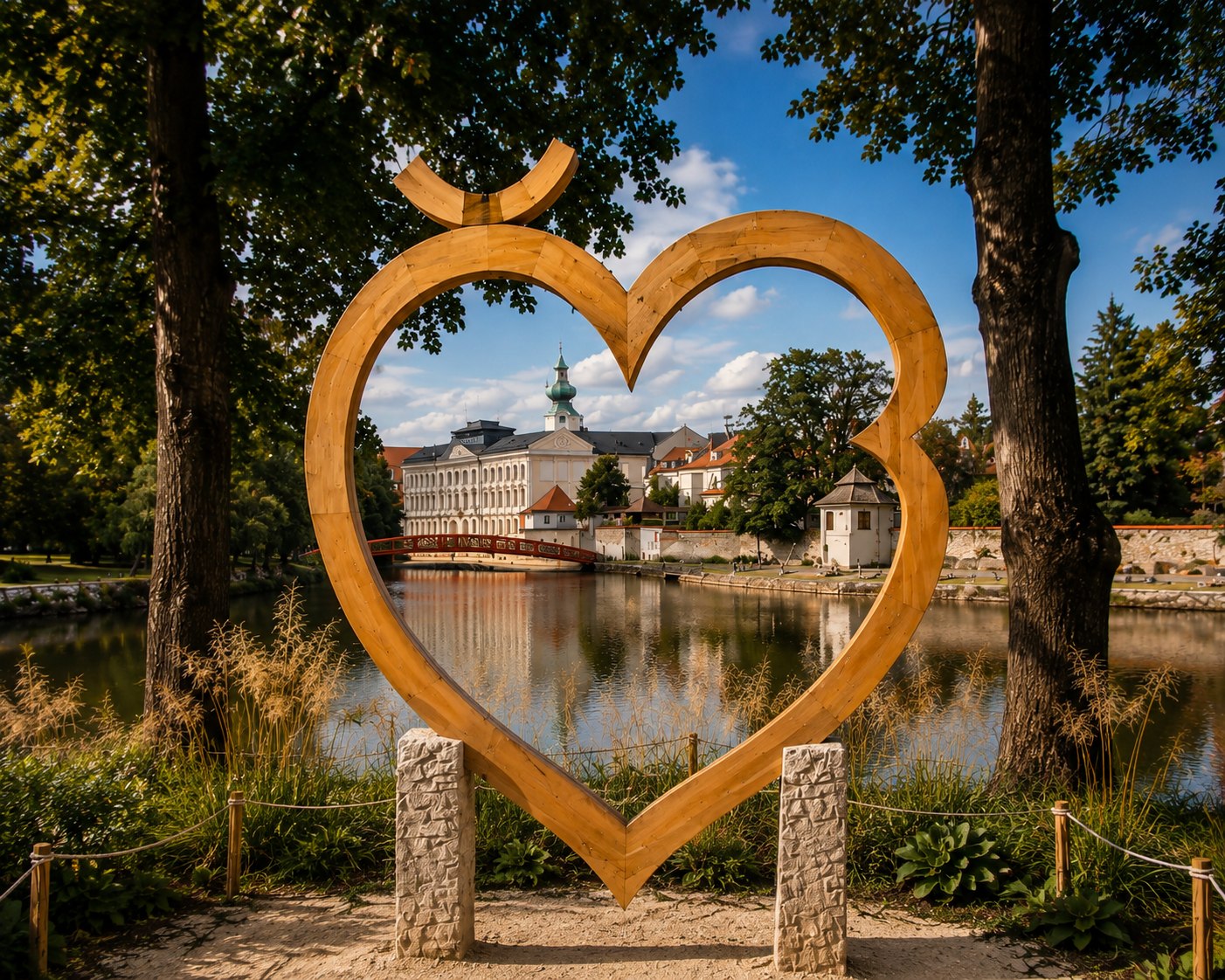
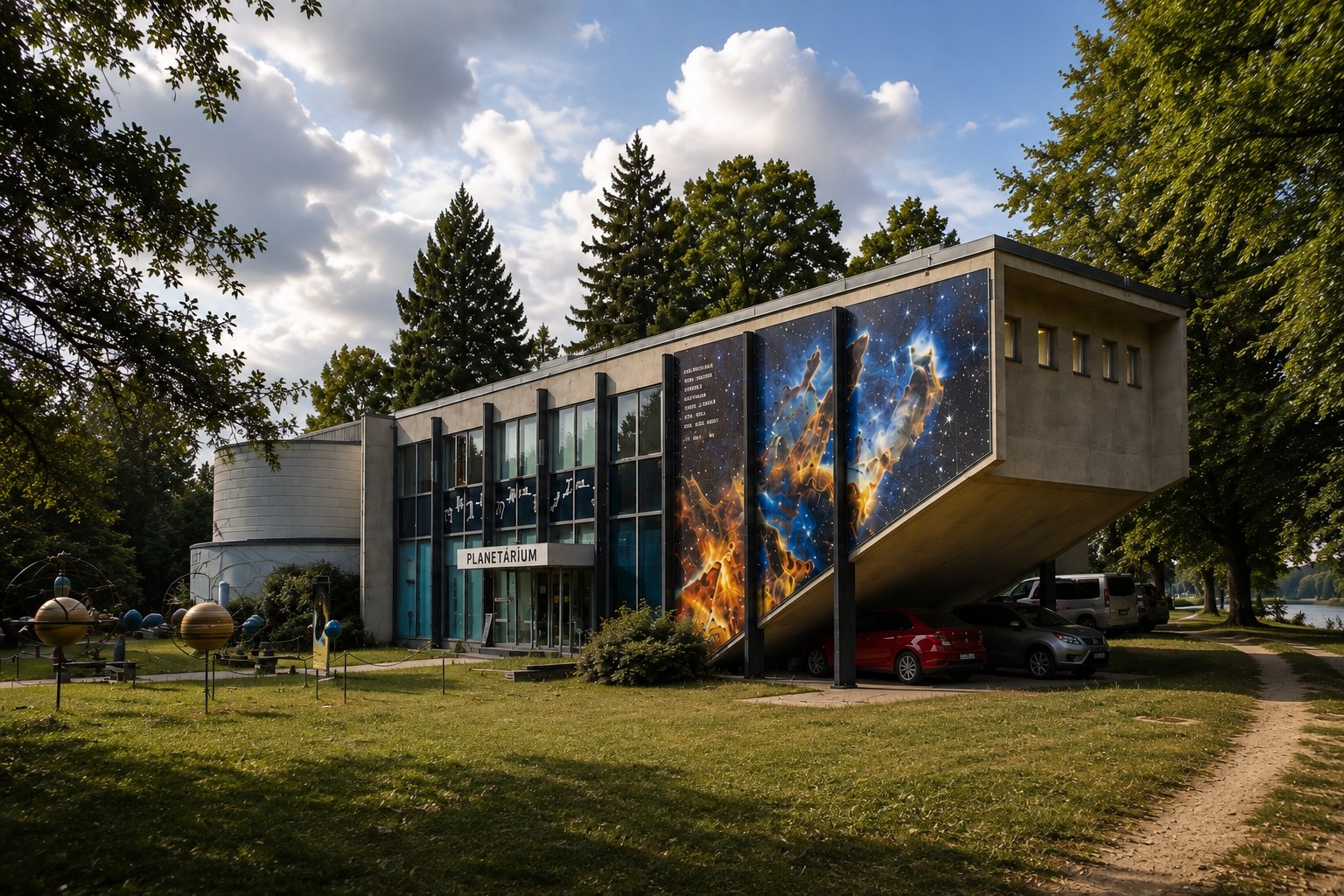
Observatory and planetarium České Budějovice
The observatory and planetarium in České Budějovice stand in Háječek park by the river and grew from a public collection organised in the 1920s by a group of amateur astronomers — no patron, only membership fees and gifts. It opened on 14 November 1937 as the second public observatory in Bohemia after Ondřejov, and until the mid-1950s was run purely by volunteers. Today a 1961 Zeiss projector still works after more than sixty years, and the institution has a second, harder-to-reach workplace high on Kleť, where a married couple of astronomers discovered over a thousand asteroids.
Kleť Observatory — KLENOT and the asteroid hunters
Kleť Observatory lies below the summit of the Blanský les and is the highest-sited observatory in Czechia — and because it stands above the inversion, it also has the most clear nights in the country. It is led by the couple Jana Tichá and Miloš Tichý, who with their team discovered over a thousand asteroids and in 2022 took part in one of only five cases in human history when an asteroid’s impact on Earth was predicted before it happened. Jana Tichá has also since 2003 chaired the international committee that approves names for all asteroids and comets in the solar system — not only Kleť’s.
Lanna’s trace — avenue, monument and boatyard
The street you take from the station into the centre is named after a man born in a boatyard who began as an oarsman in his father’s firm. From it he built an operation that in one year dispatched three hundred and fifty boats — and when the railway came, he did not resist it. He folded it into his system and had freight hauled to the river on it.
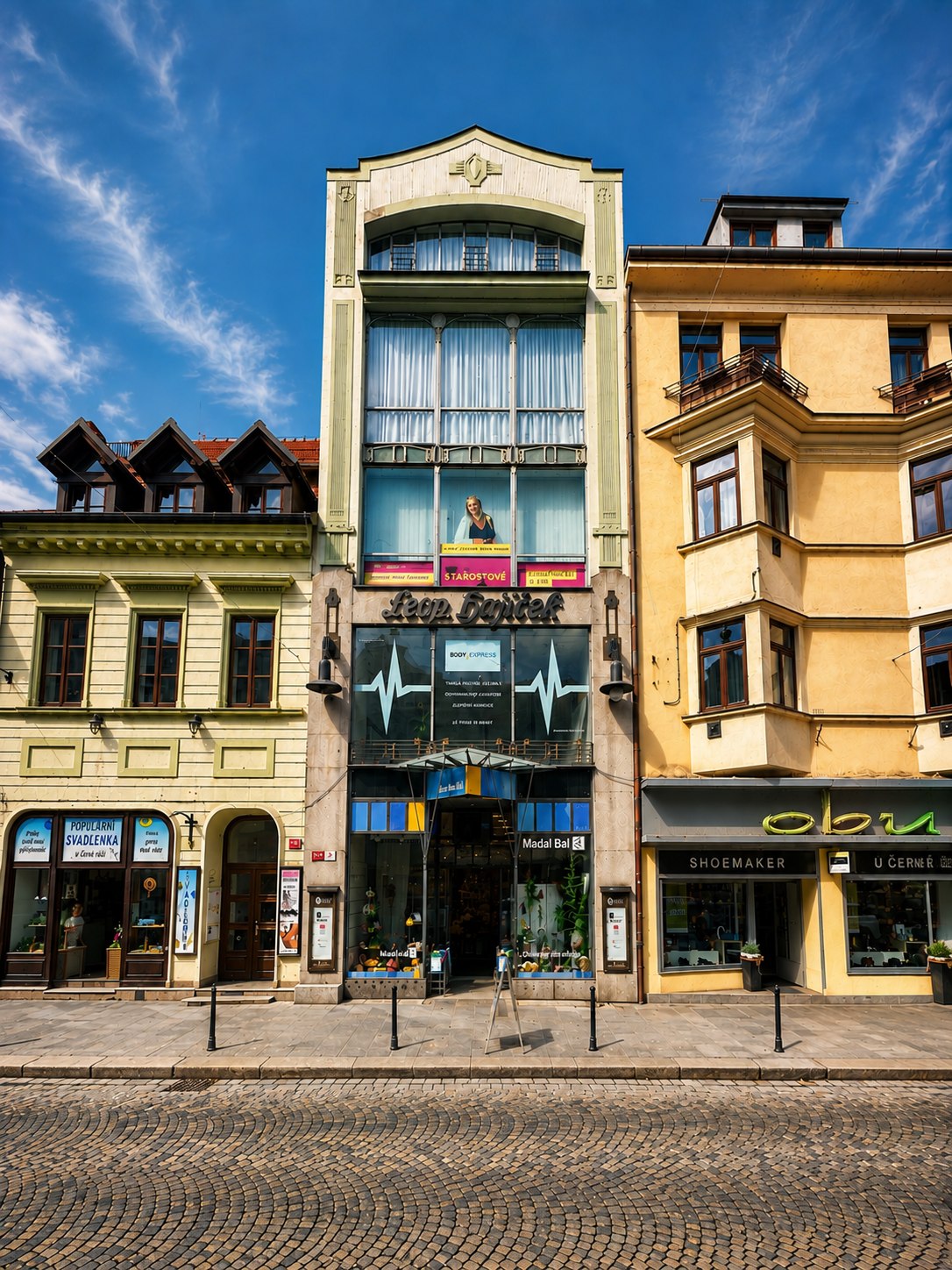
Hajíček department store
Opposite Wortner House stands a 1910 building whose almost entire façade is large panes of mirror glass in slender iron frames. It was the first modernly designed department store in the town and probably in all of South Bohemia. Almost no one sees it — the opposite houses reflect in it, and in the narrow street people look ahead.
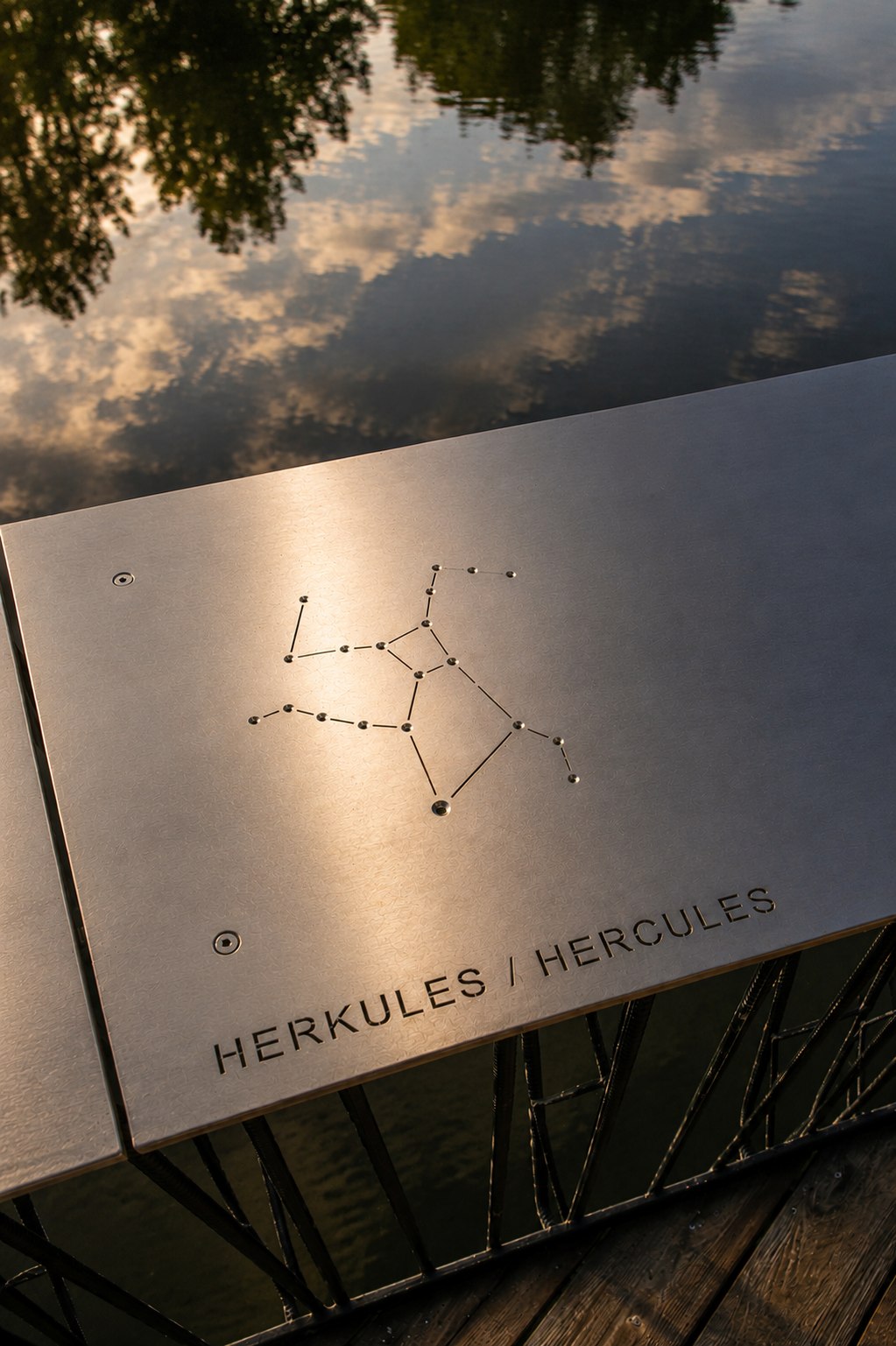
The pier in Háječek
A wooden platform on piles driven into the bed, exactly at the confluence of the Vltava and Malše — where the town arose in 1265. The railing looks ordinary, but twenty-four constellations are milled into its handrail. At night they light, but only downward and inward, so as not to disturb the observatory a few steps away.
At the Green Sprig — where the horse railway reached for Lanna
A coaching inn of 1821 with stables, stores, workshops and flats for coachmen. In 1838 Vojtěch Lanna had a horse-railway siding brought here — so that freight could transfer straight onto boats or wagon trains. It is the only place in town where railway, wagons and river met in one courtyard. And it still stands.
Zátka House — the bust on Krajinská
On a house on Krajinská is a bust of a man who spent eight years trying to negotiate peace between Czechs and Germans in one town. The agreement was approved in May 1914. Three months later the war began and it was worthless. The bust is by Bohumil Kafka — the same sculptor who made Žižka on Vítkov.
Holašovice
Holašovice is a South Bohemian village sixteen kilometres from Budějovice that has been on the UNESCO World Heritage list since 1998 — and it is not an open-air museum, but a living village where people still live in those farmsteads. Around a rectangular green with a pond, chapel and smithy stand twenty-two buildings in the rustic Baroque style — ornate white façades that prosperous farmers built for themselves at the end of the 19th century. More interesting than the façades is that the population of this village was almost entirely replaced twice in five centuries — and the houses survived.
Kleť — Josefova věž lookout and cable car
On the summit of Kleť, the highest mountain of the Blanský les, stands since 1825 the oldest stone lookout tower in Bohemia — and it was built not by a town or tourist club, but by Prince Josef of Schwarzenberg for his family’s private use. It was called Josefova věž. And it has one detail almost no one notices: the Schwarzenberg family arms contain a silver tower with battlements standing on a hill — and the lookout looks almost the same. The prince apparently had his own coat of arms built life-size into the landscape.
Vrbenské ponds
Vrbenské ponds are a nature reserve on the north-western edge of České Budějovice that you can reach by city transport — and 193 bird species have been recorded there, of which more than eighty nest. A four-kilometre educational trail with ten stops runs along the dikes. According to observers the birds here are less shy than elsewhere, so they can be watched from closer than usual.
Doudleby
Doudleby is an unassuming village on the Malše twelve kilometres from České Budějovice — and it was the administrative centre of South Bohemia at a time when Budějovice did not yet exist. A Slavic hillfort stood here that belonged directly to the Přemyslid princes and governed the whole region until the end of the 12th century. Today the church of St Vincent stands on its site and the ramparts are still visible in the terrain.
Besednice moldavites
Besednice by Trhové Sviny is the best moldavite locality in Czechia, and its stones are among the most valuable in the world to collectors because of exceptionally deep sculpted surfaces — called hedgehogs. It is a nature monument where any interference with the soil is forbidden, and every year the police find new traces of illegal digging. Anyone who wants to dig a moldavite themselves and keep it legally can — but only at the commercial dig by Besednice run by the Český Krumlov Moldavite Museum.
Trocnov — Jan Žižka Memorial
Trocnov by Borovany is the place where according to tradition Jan Žižka of Trocnov was born — the Hussite commander no one ever defeated. A granite monument, two archaeologically uncovered farmsteads, an educational trail and, from 25 April 2026, a brand-new visitor centre with a museum exhibition (free entry) stand here. What is interesting is how much about Žižka we do not know: we do not know his birth year, and historians still disagree whether the man in the oldest charter with his name was him or his father.
Kočičí aféra 1924
Tohle se opravdu stalo. Není to pověst a nemá se tak vyprávět. Je zapsaná sem, protože se objevila při hledání pověstí a byla by škoda ji ztratit — ale v průvodci patří jinam.


Budějovice legends
Open all legends- Legend
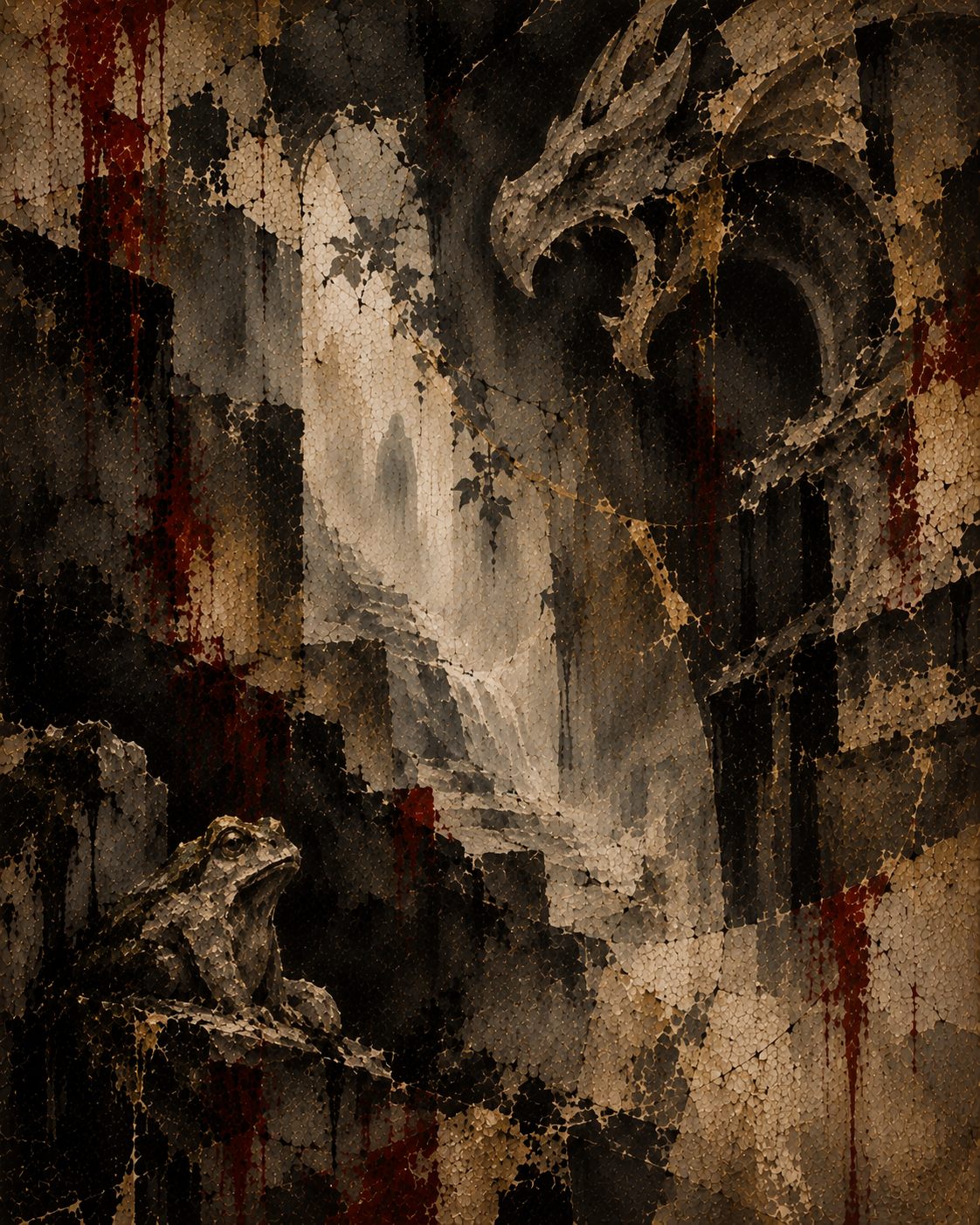
The Stone Dragon and the Stone Frog
On the outer wall of the Church of the Presentation of the Virgin Mary on Piaristické náměstí in České Budějovice sit two stone beasts. Legend says they did not end up there by chance: the dragon once guarded the gate of a hunting lodge, the frog sat above the gate of a castle where a girl was held for years — brought there one November night in a cloak, with no one ever saying why. It is the founding legend of České Budějovice.
- Legend
The Brave Nun
Three thieves broke into the monastery church in České Budějovice at night to seize the Marian treasure. A nun kneeling there alone finally locked them in the sacristy and rang the bell for help. Legend says their likenesses became the three stone faces still on the façade of Solnice on Piaristické náměstí.
- Legend
Ondřej Puklice of Vztuhy
On 25 May 1467 rebels dragged mayor Ondřej Puklice of Vztuhy from a house on the Budějovice square and beat him. He died over six days. What happened in that house was written down by his son Jan, who was locked in the chamber with his father. Most of the detail in this chapter is therefore not storytelling, but testimony.
- Legend
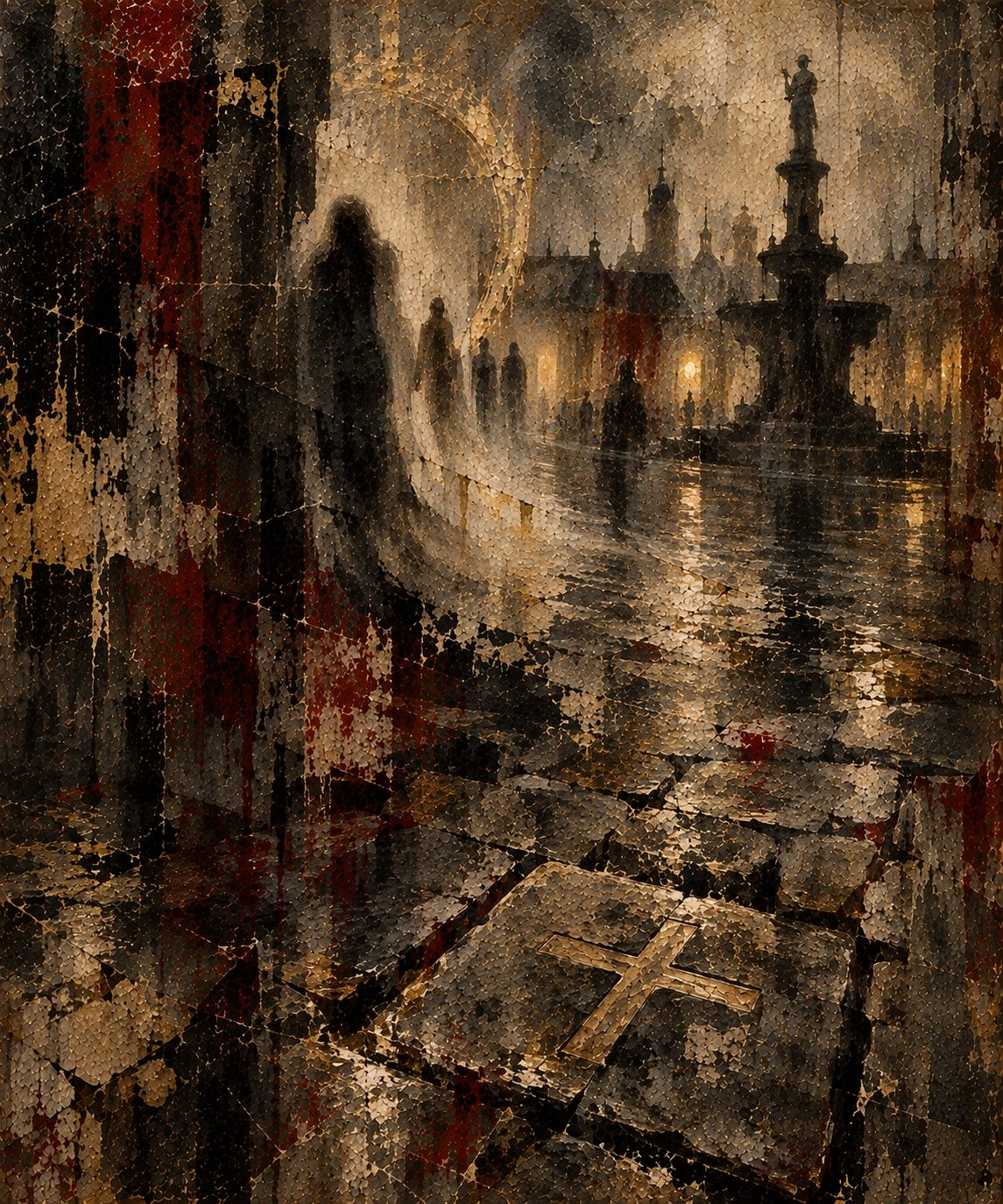
The Wandering Stone
In the paving of Přemysl Otakar II Square in České Budějovice, a short way from Samson’s Fountain toward Hotel Zvon, lies a stone with a carved cross. According to superstition, anyone who unwittingly steps over it after nine in the evening loses their way in the town and will not find the path until night has passed. Beneath that superstition lies a real mass execution of ten young men.
- Legend
The Water Spirit
To children playing near Doubravice by České Budějovice came an unknown man with a carved flute and began to play. They followed him as if enchanted. One boy stayed behind and saw the water at the pond part and close again. It is the same material as the Pied Piper of Hamelin, only with a different ending.
- Legend
Šimon Plachý, town clerk
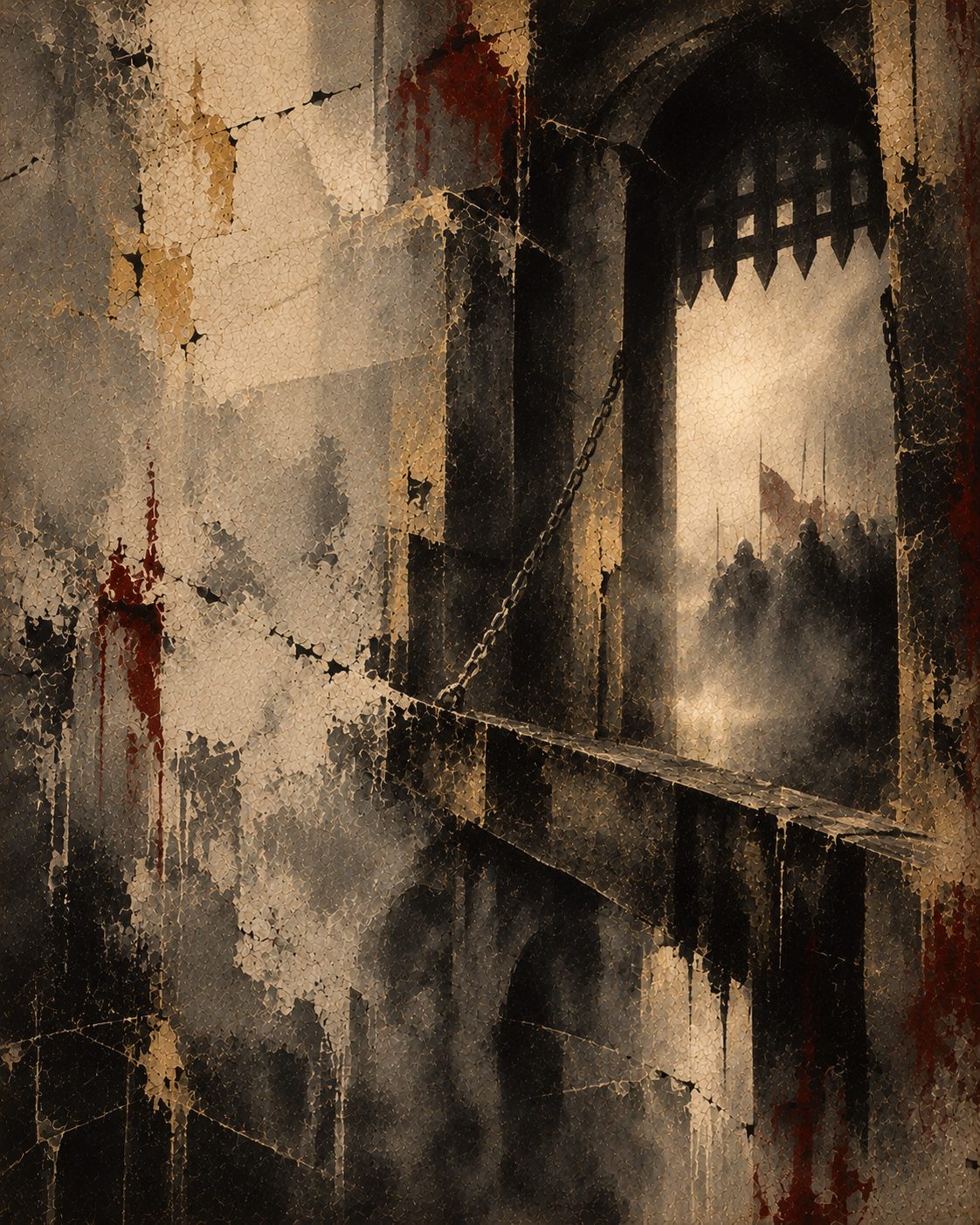
On 31 January 1611 well-fortified České Budějovice surrendered without a fight. It was enough for a coachman to stop a carriage on the drawbridge of the Prague Gate so that it could not be closed. Town clerk Šimon Plachý of Třebnice, who was officially overseeing the opening of the gate, was shot that morning.
- Legend
Ondřej Kodelík, town clerk
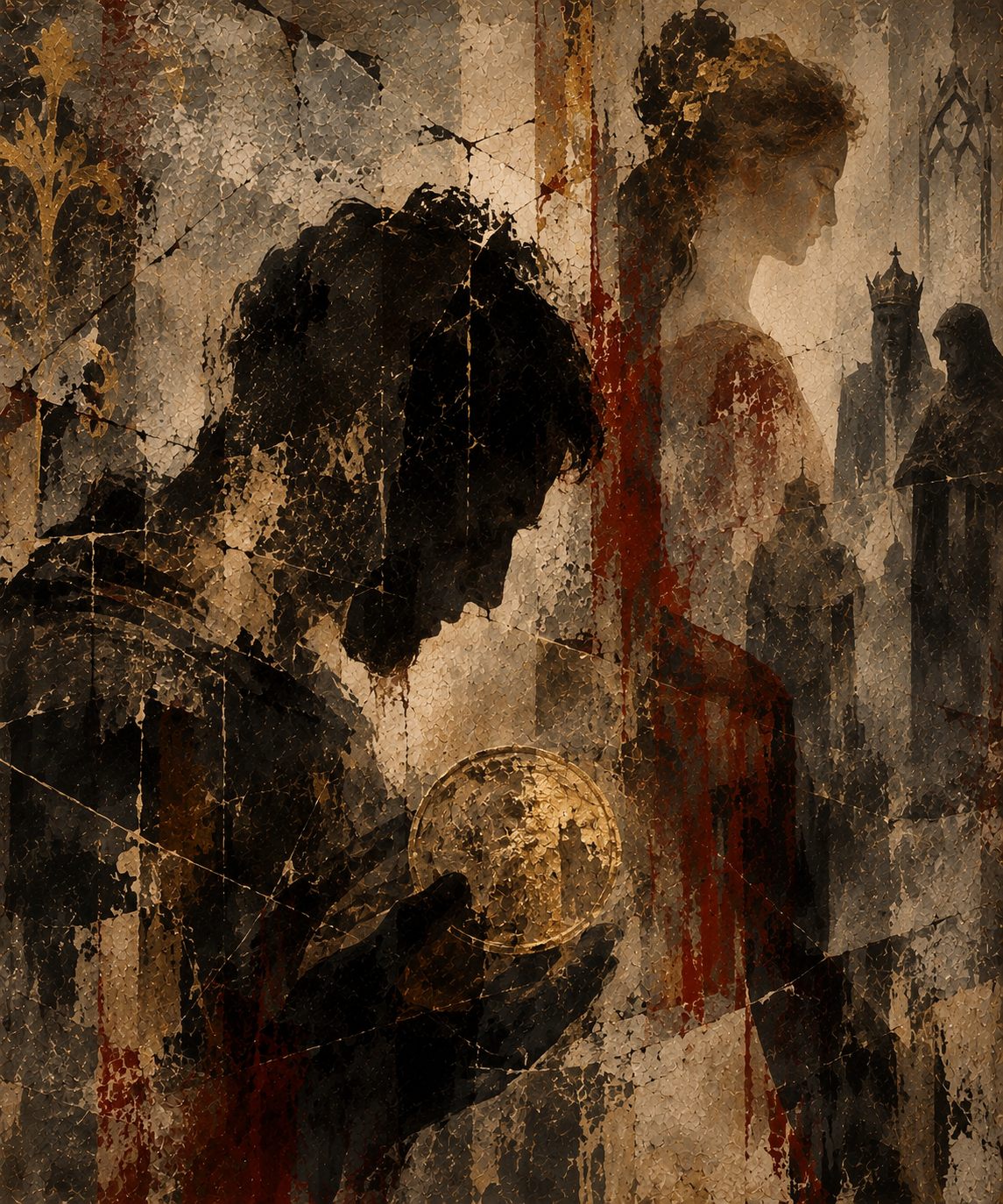
In 1614, because of plague in Prague, the provincial diet met in České Budějovice and the town welcomed King Matthias with Anna of Tyrol. The Latin welcome speech was delivered by town clerk Kodelík. Legend added to that historical event a story of a foundling who did not know who his parents were.
- Legend
Treason upon treason
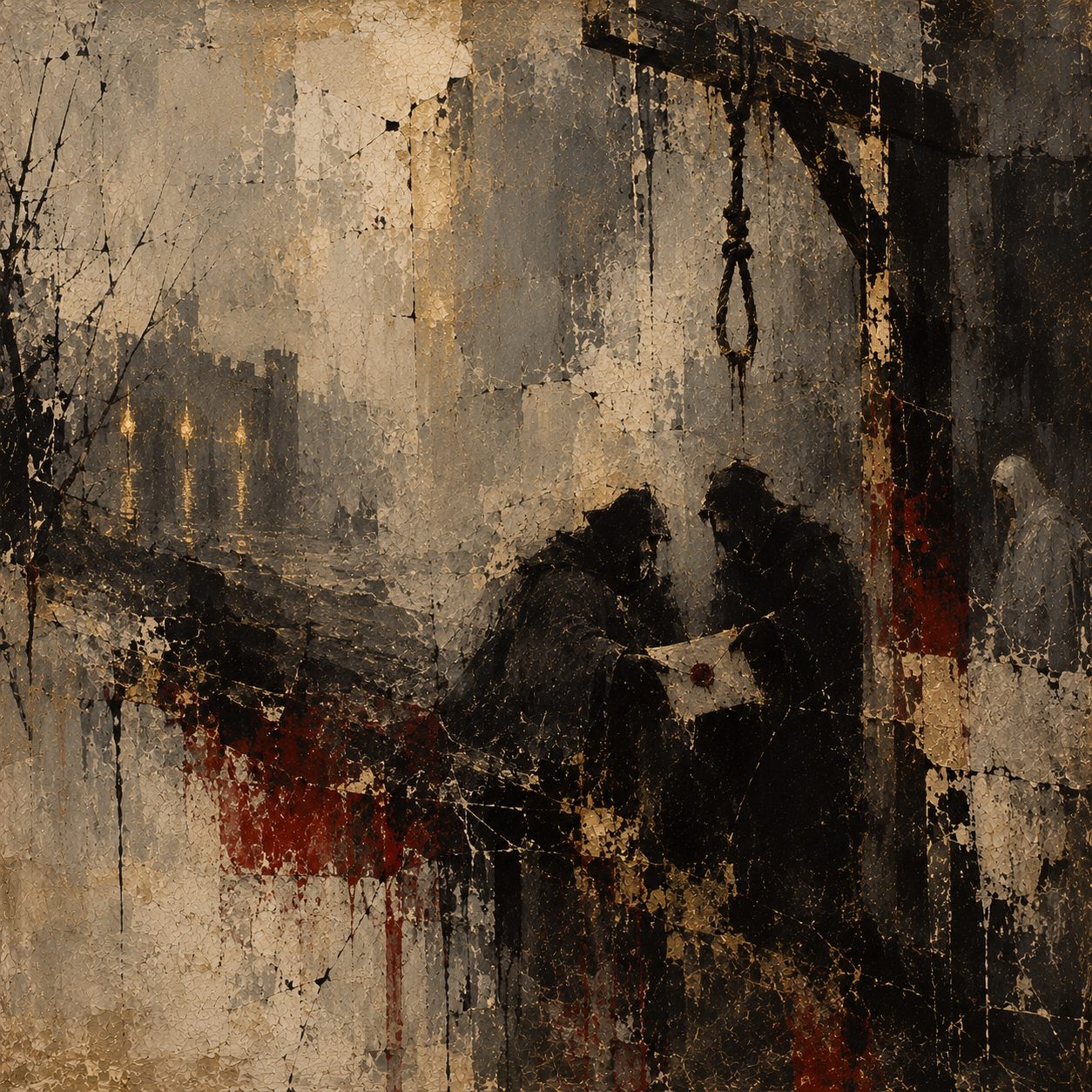
In spring 1619 the Estates army lay before České Budějovice and an officer inside the walls wanted to surrender the town. A woman betrayed the plot. On 7 May 1619 Captain Weisbach was executed in Budějovice. This is not a legend; it is a documented event that legend later wrapped in names and one night.
- Legend
The bakery at the Capuchins
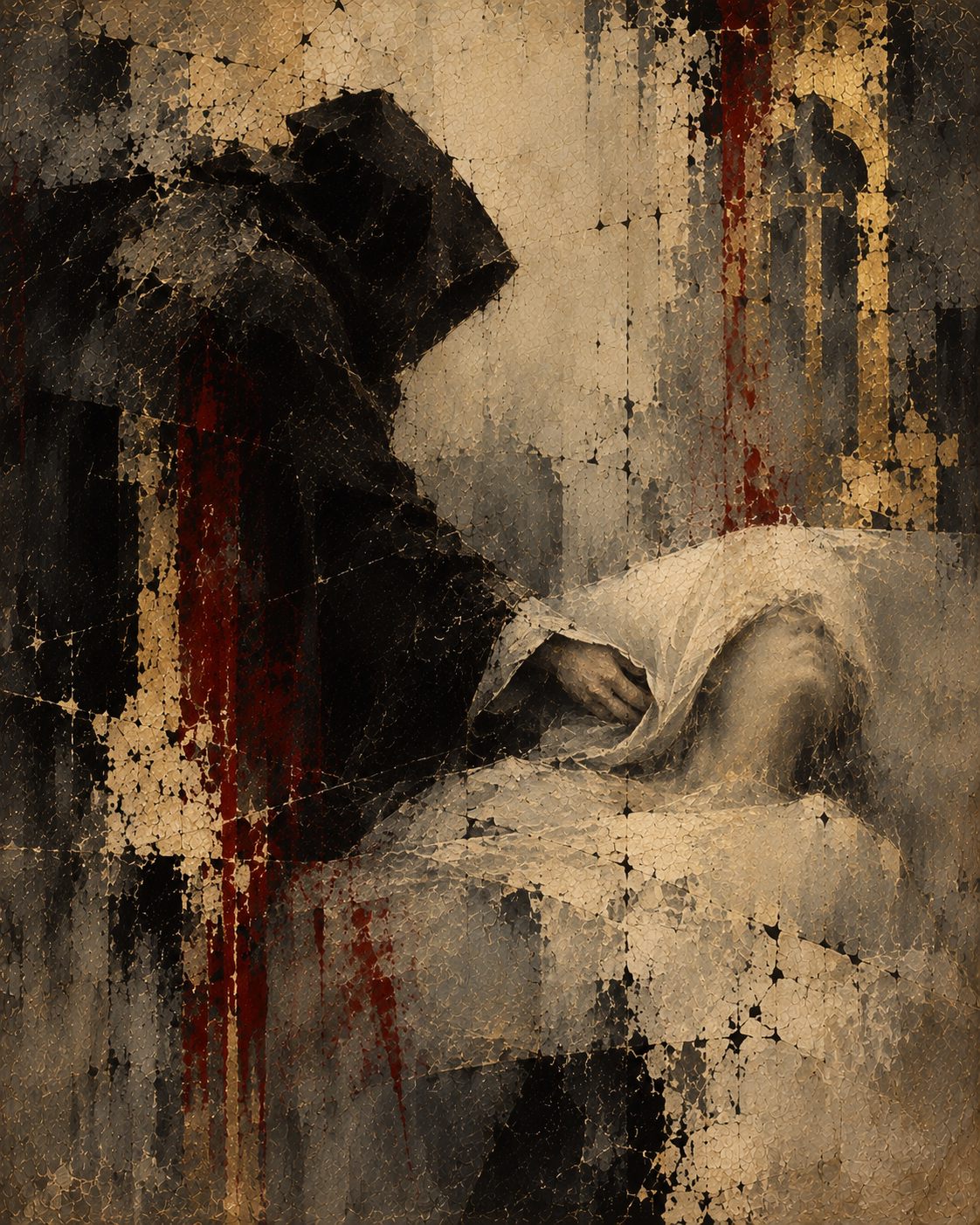
The Capuchin monastery on Kněžská street in České Budějovice needed the neighbouring yard, and the baker would not sell. Only when after his death his widow was dying did a priest come from next door to hear her last will. According to the legend he then put his hand under her pillow.
- Legend
The headless rider
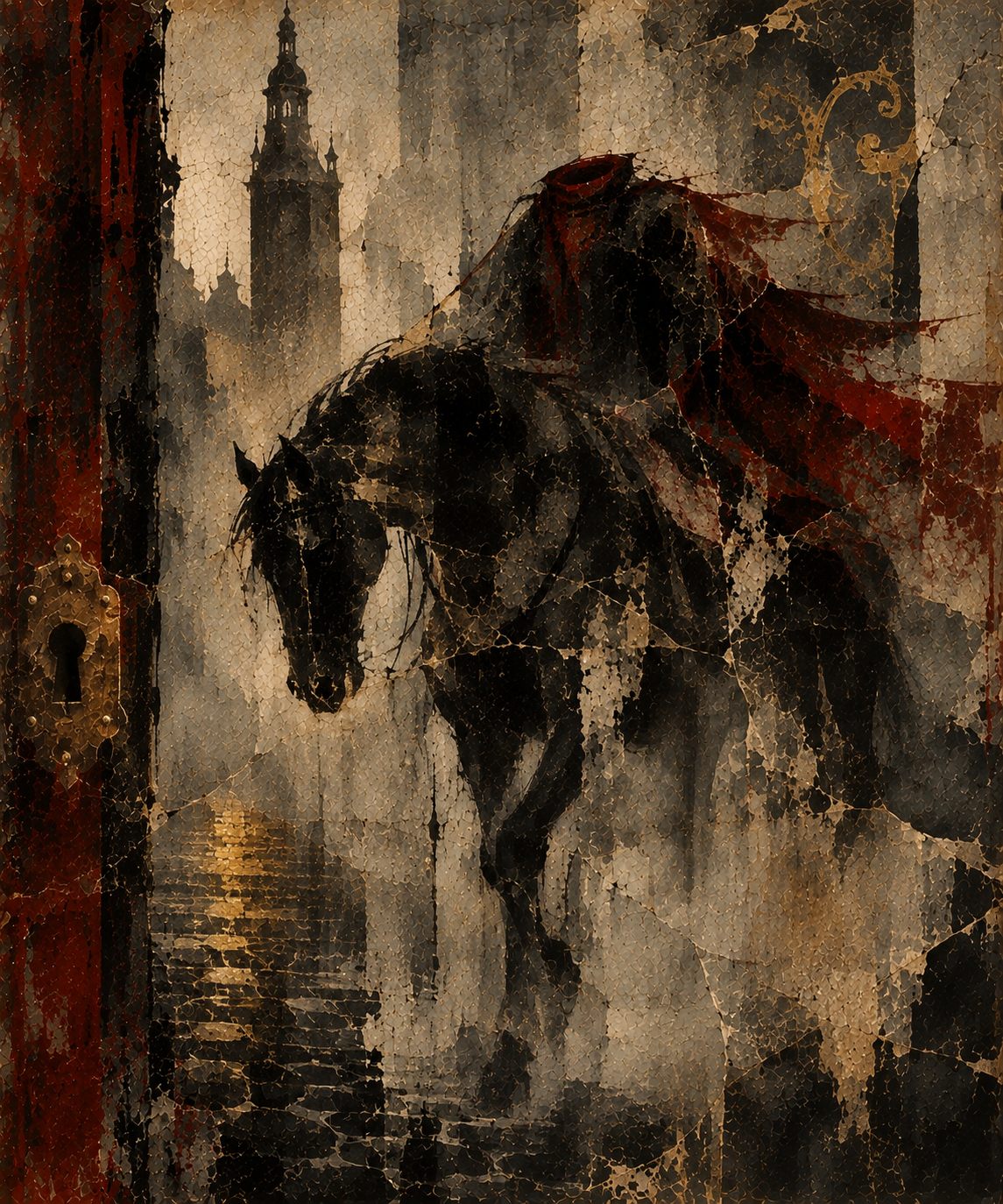
Through Budějovice streets at night a horse with a rider without a head was said to ride. Once someone followed it. It led him along Kanovnická street, today’s Hroznová and Krajinská třída as far as the gateway of a coaching inn, where it became clear what it really was. This legend refutes its own ghost.
- Legend
Bummerin
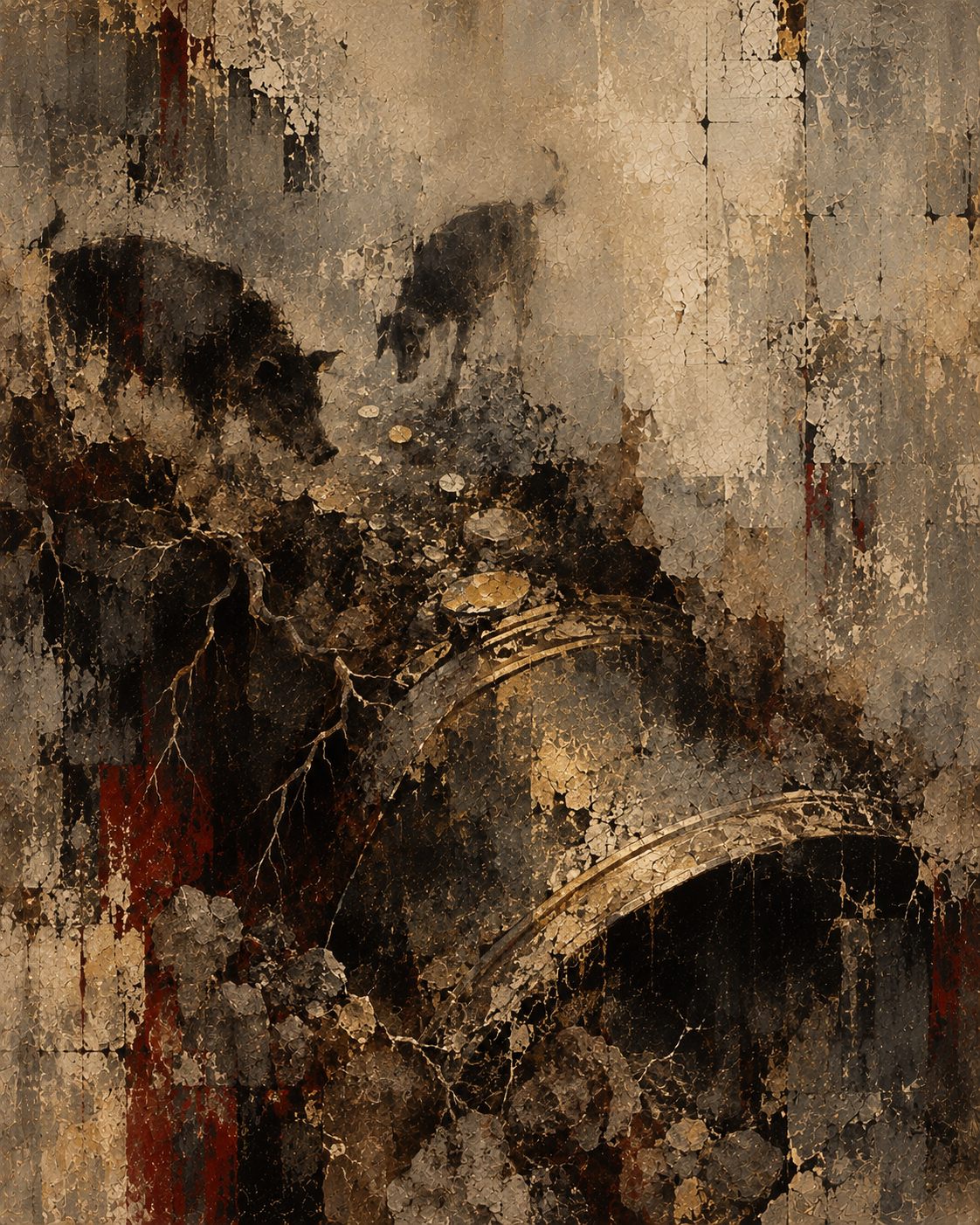
On the Black Tower hangs Bummerin, its largest bell. Legend says it was found buried on Pig Meadow near Lišov by a swineherd’s dog and pig — and that Lišov sold it to Budějovice because their own tower could not hold it. The real bell of 1507 cracked in 1723 and was recast; today it weighs 3,429 kilograms.
- Legend
The ghost in the storehouse
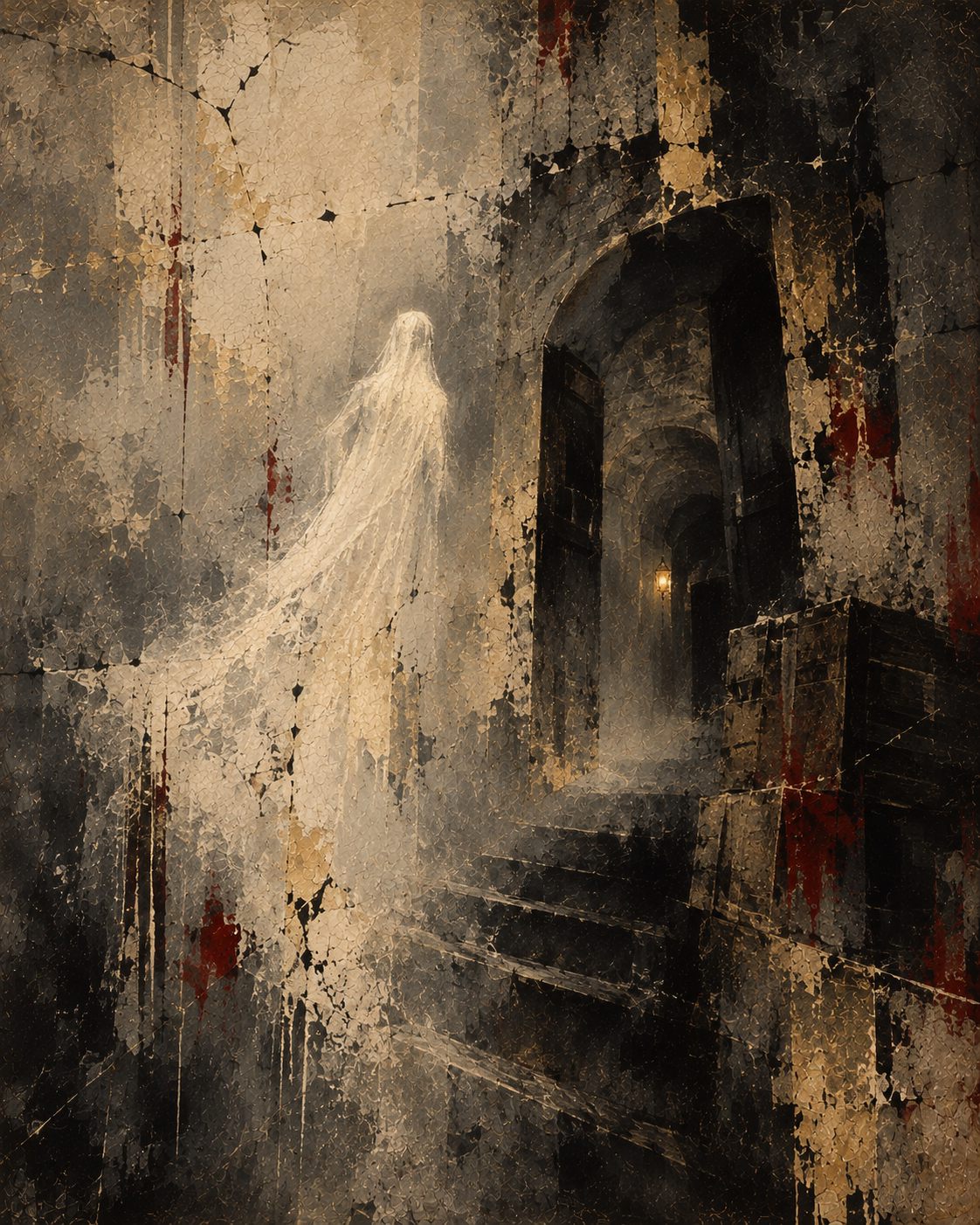
In the military bakery at the corner of Pražská třída and Pekárenská street in České Budějovice a White Lady was said to appear at night. Once she took the baker by the hand and led him toward a door no one knew. He did not go all the way.
- Legend
The treasure
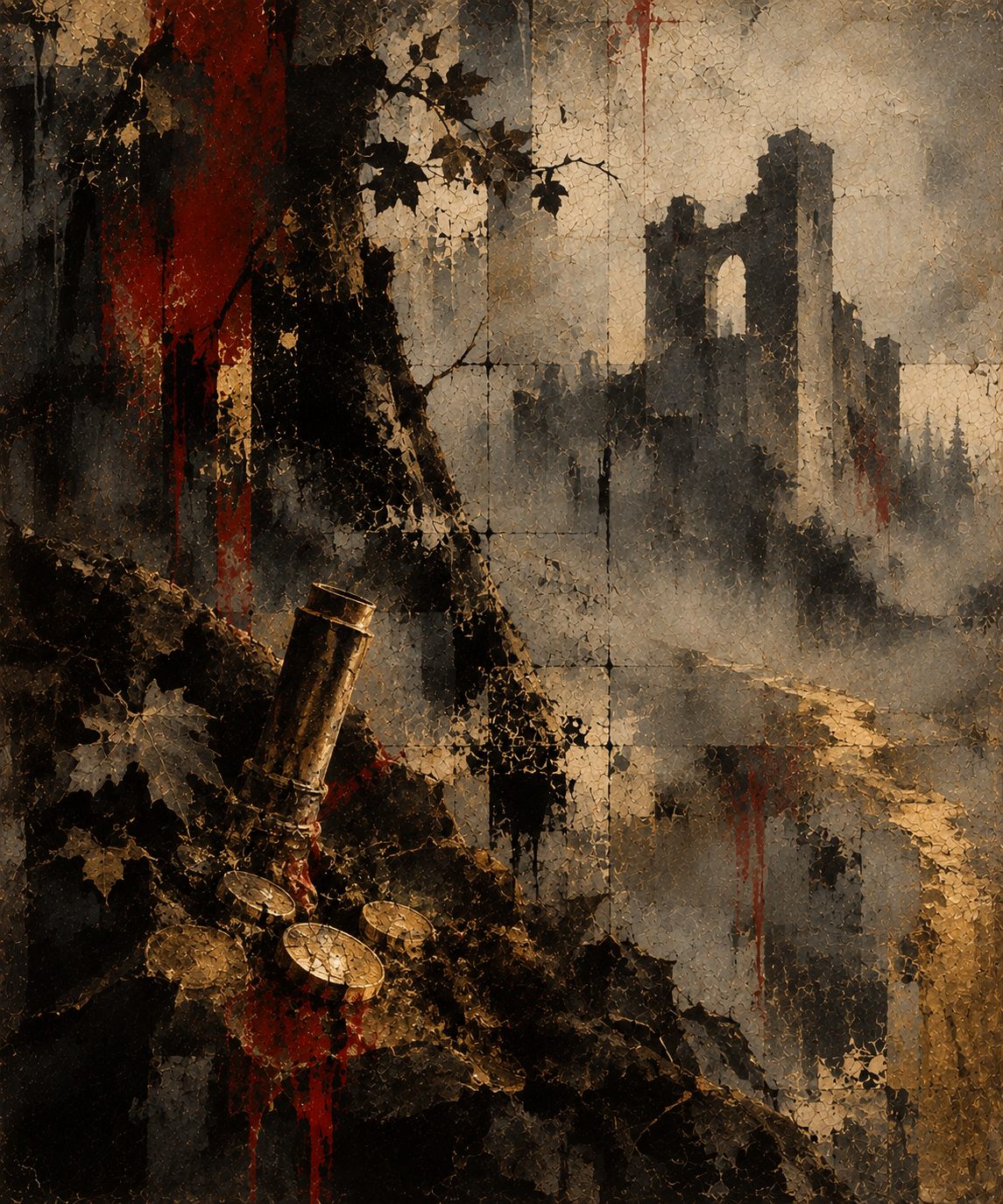
Tomek’s wood by Roudné near České Budějovice has a treasure legend. A rich owner had it hidden and killed those who helped him. On Palm Sunday a gun barrel appears above the spot. Whoever goes for the treasure must walk there and back in silence.
- Legend
The mysterious barrel
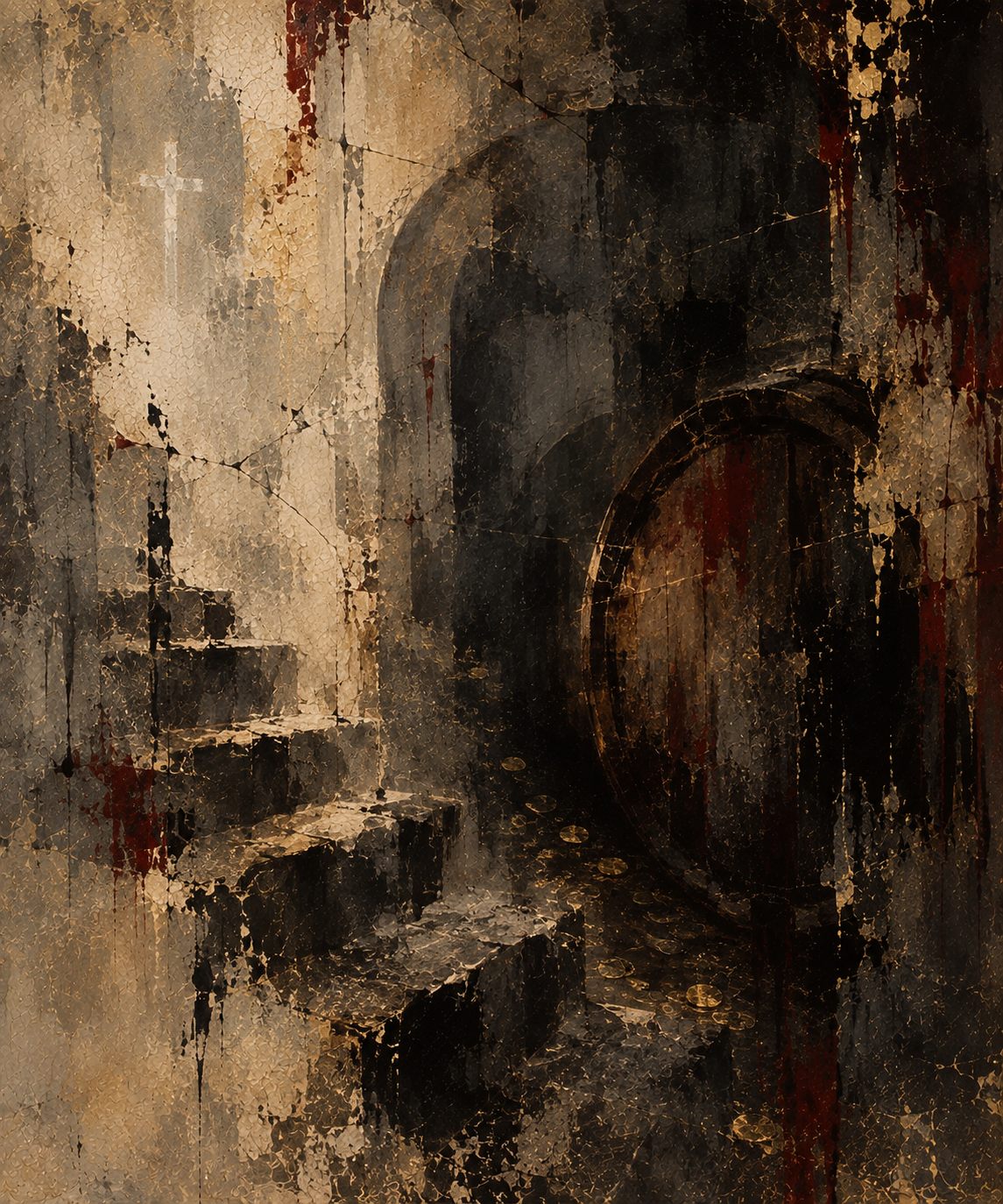
In a house on Česká street in České Budějovice every night at eleven the same sound came from the corridor: as if someone were rolling a barrel down the stairs into the cellar and pouring money out of it. No one ever saw the barrel.
- Legend
The hearse
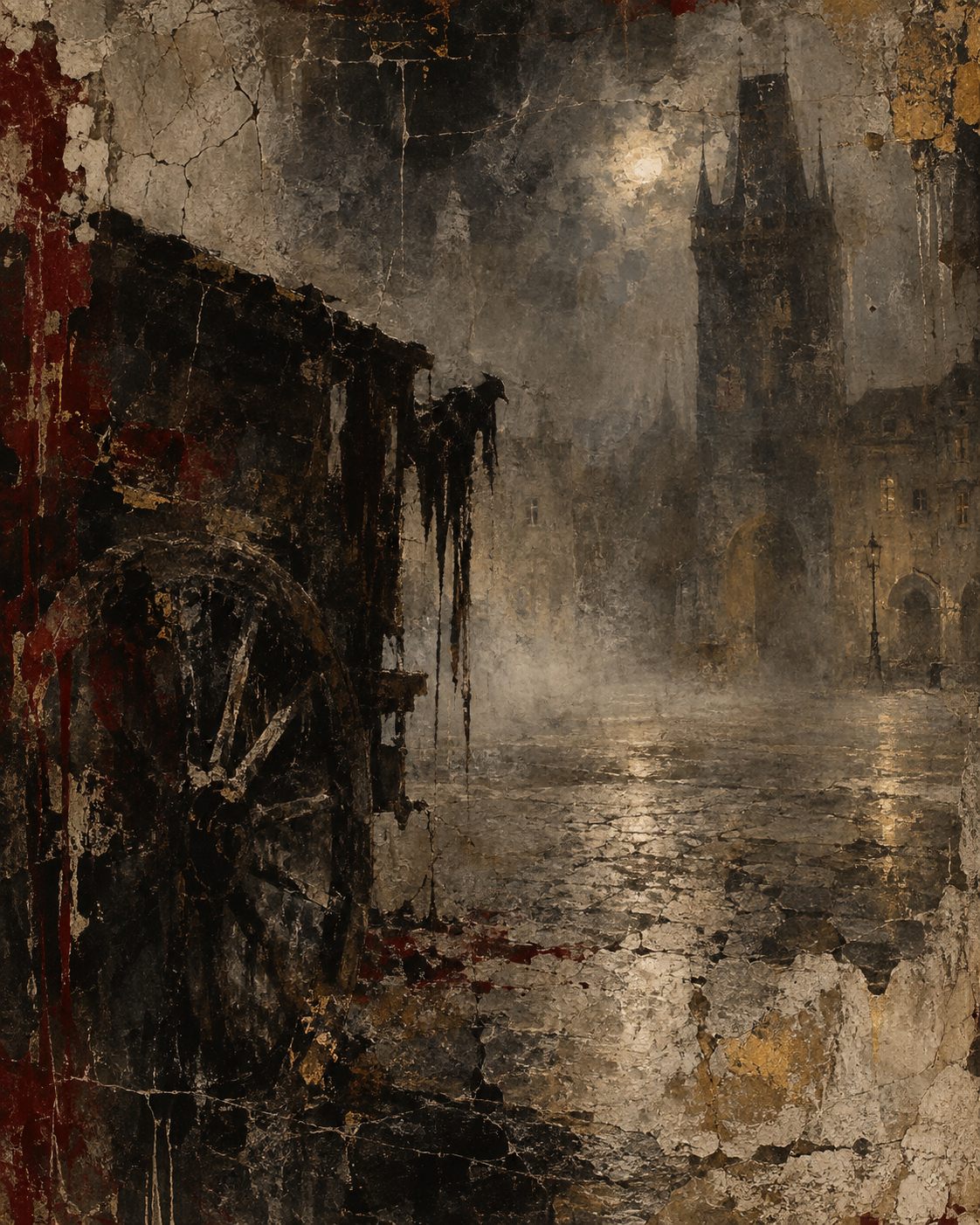
On the open ground between the Black Tower and the deanery in České Budějovice, once called the Fruit Market, the town hearse was said to stand. It was told that between eleven and midnight it drove off by itself. One Budějovice tailor wanted a free ride.
- Legend
The ghost in Veit’s yard
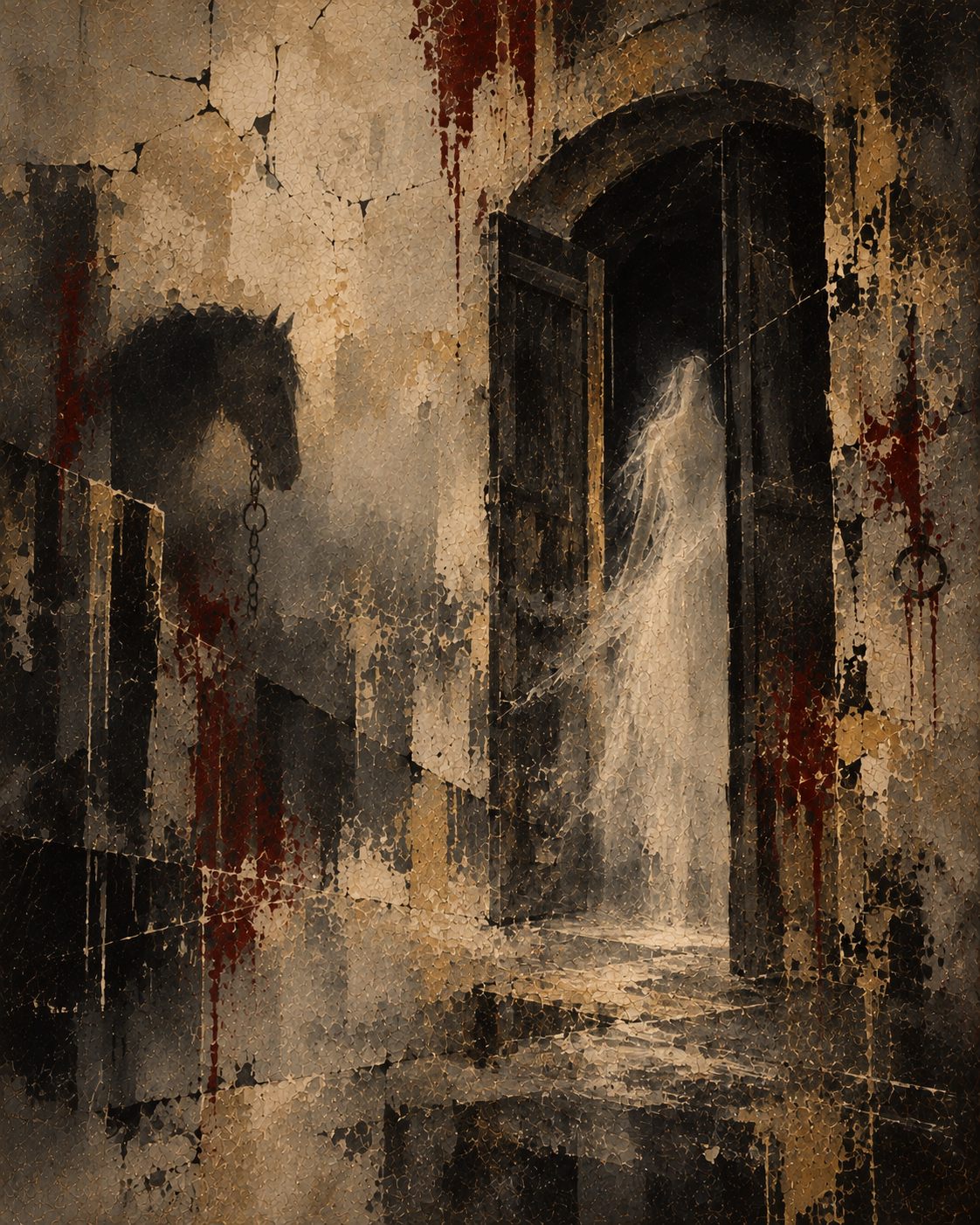
Veit’s yard stood in the Prague suburb of České Budějovice, beyond the church of St Procopius and St John the Baptist. The owner once spent the night there to test the honesty of his servants. The door he had locked opened by itself in the night.
- Legend
The Prussians in Budějovice
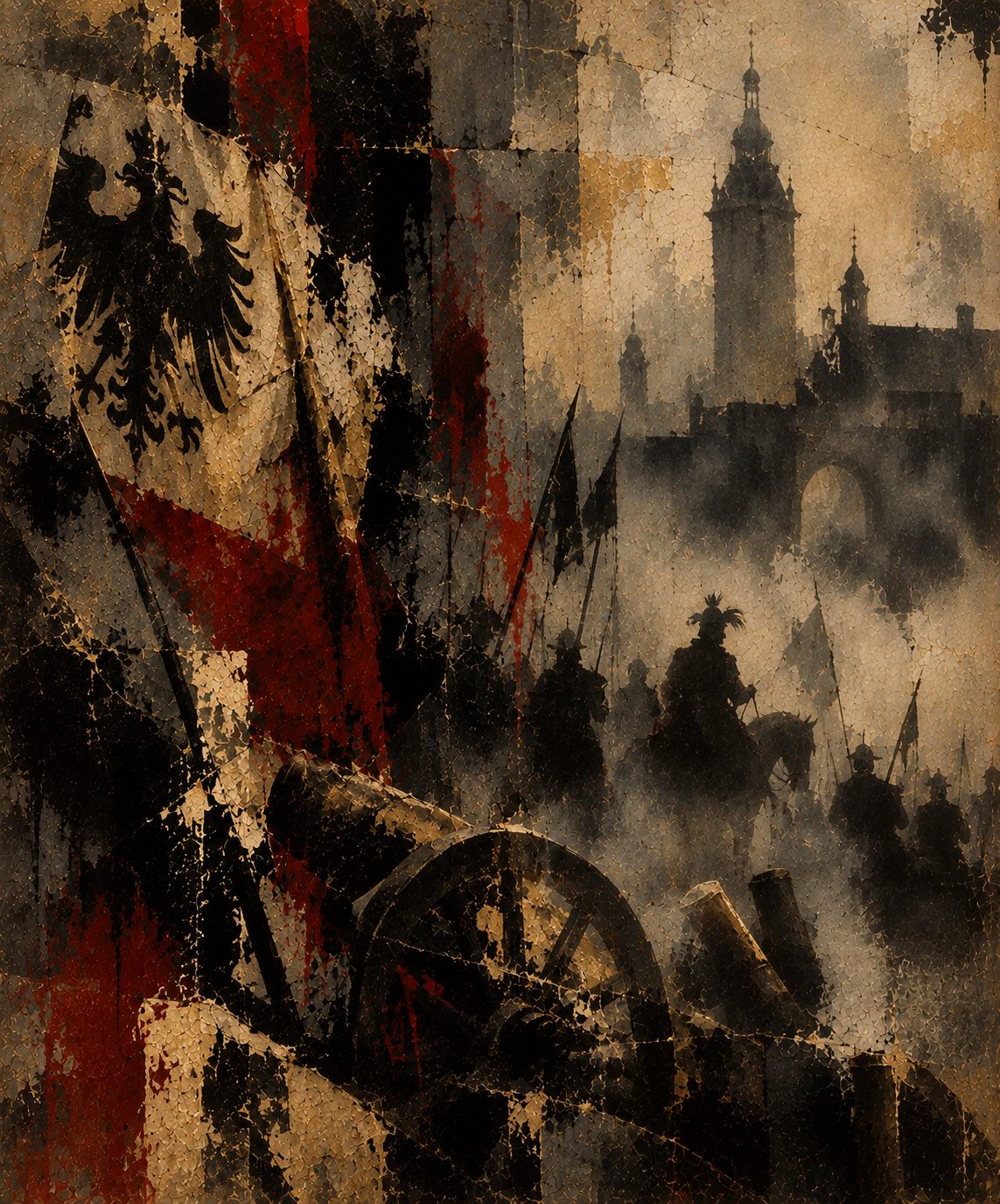
On 29 September 1744 the Prussians reached České Budějovice and the town surrendered the next day. Baron Trenck came to retake it with his pandours, a corps Maria Theresa had assembled from men no one else wanted. The decisive attack came on the night of 21–22 October 1744.
- Legend
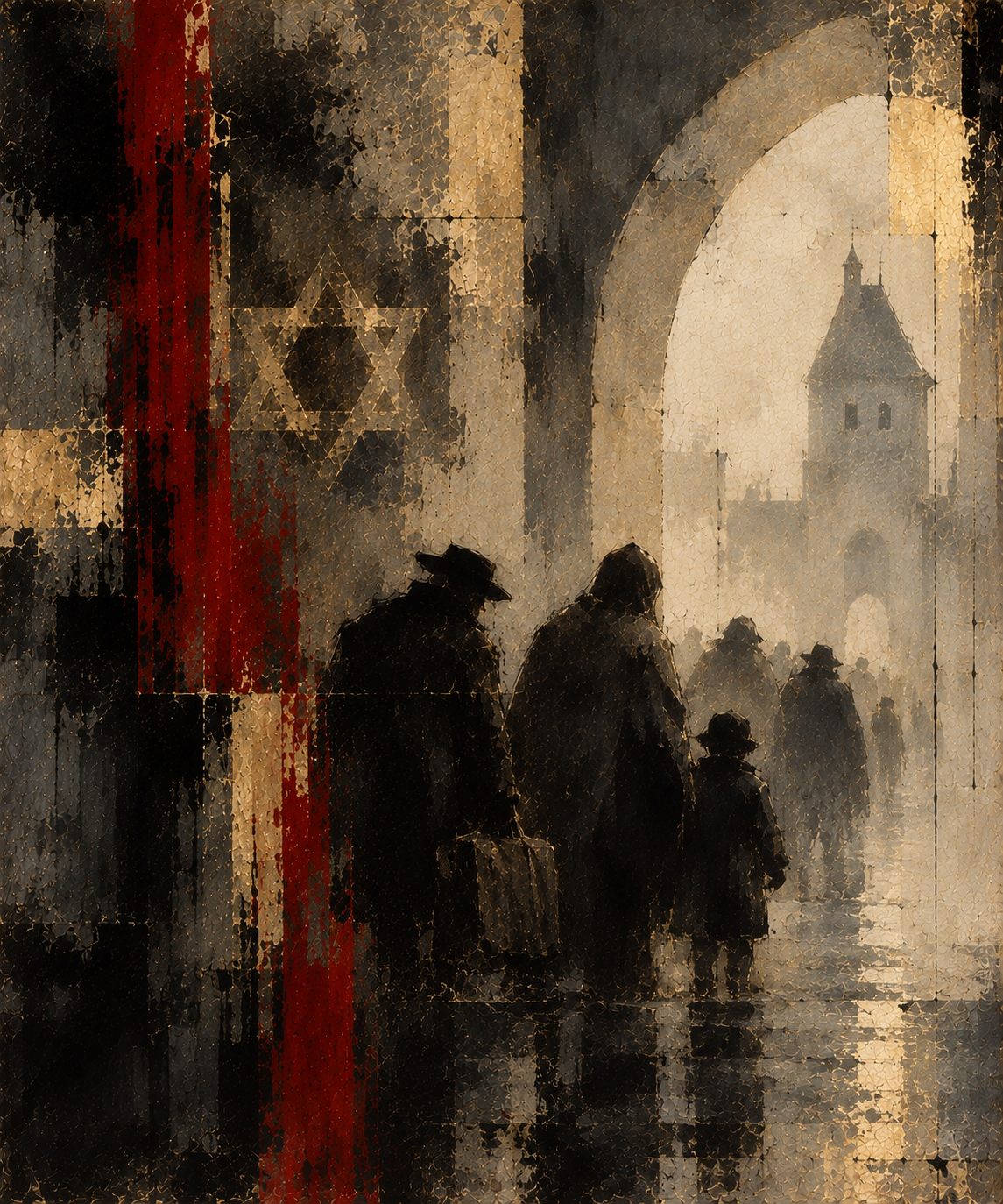
The expulsion of the Jews from Budějovice
In Jewish Street, today’s U Černé věže street in České Budějovice, a Jewish community with a synagogue and its own rabbi had lived since the 14th century. In 1505 it was accused of something that never happened. By March 1506 it had ceased to exist. This is not a legend.
- Legend
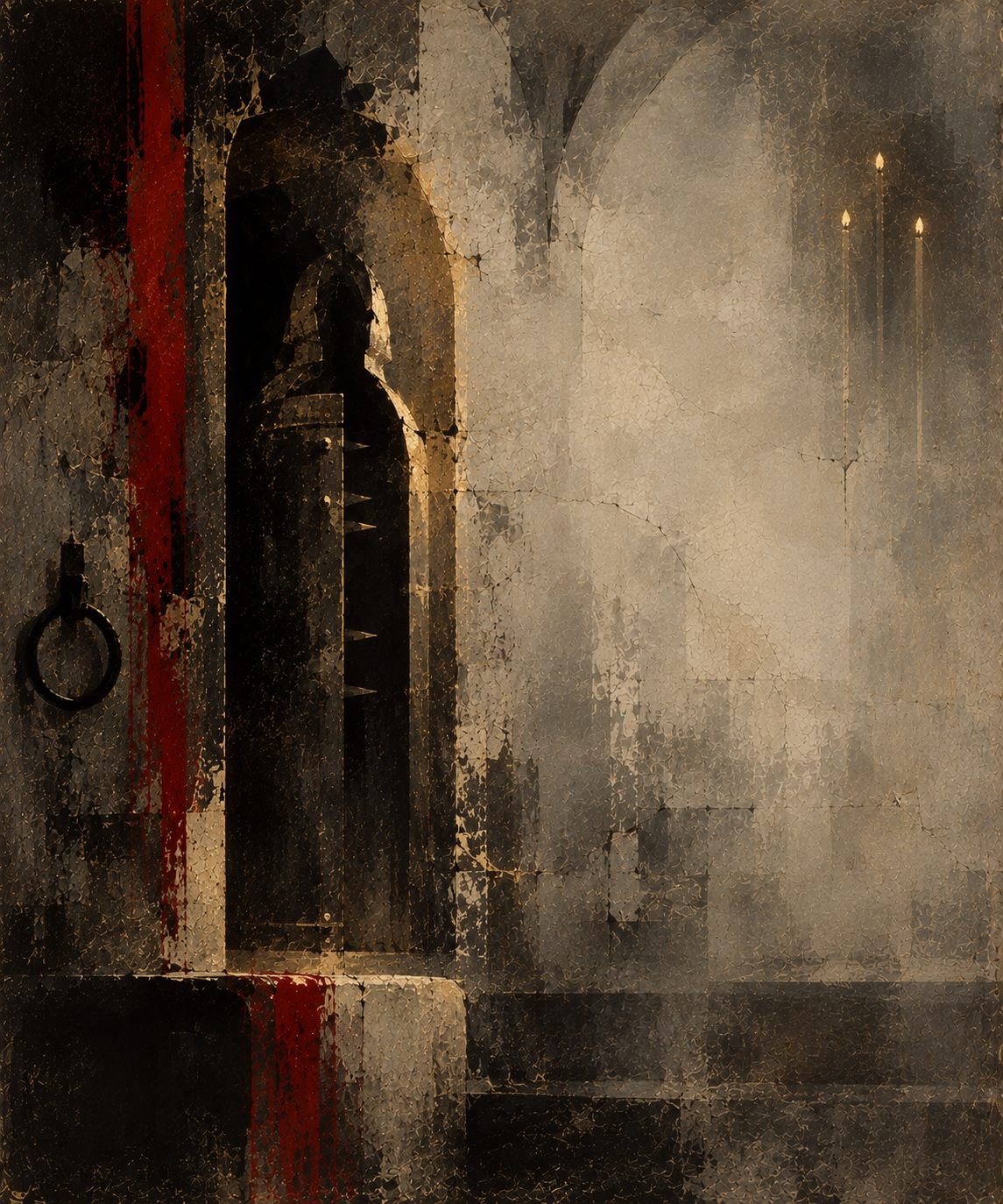
The Iron Maiden
At the corner of Zátkovo nábřeží and Biskupská street in České Budějovice stands a fortification tower called the Iron Maiden. According to legend a secret trial was held there in 1420 over a man who was to light three agreed signals on the tower for the Hussites. The tower then had another name.
 Without embellishment
Hlavní verze sleduje, jak se zrada odhalila. Tahle jde s Prokopem od dveří kobky až nahoru do soudní síně a nevynechá nic z toho, co bylo mezi tím.
- Legend
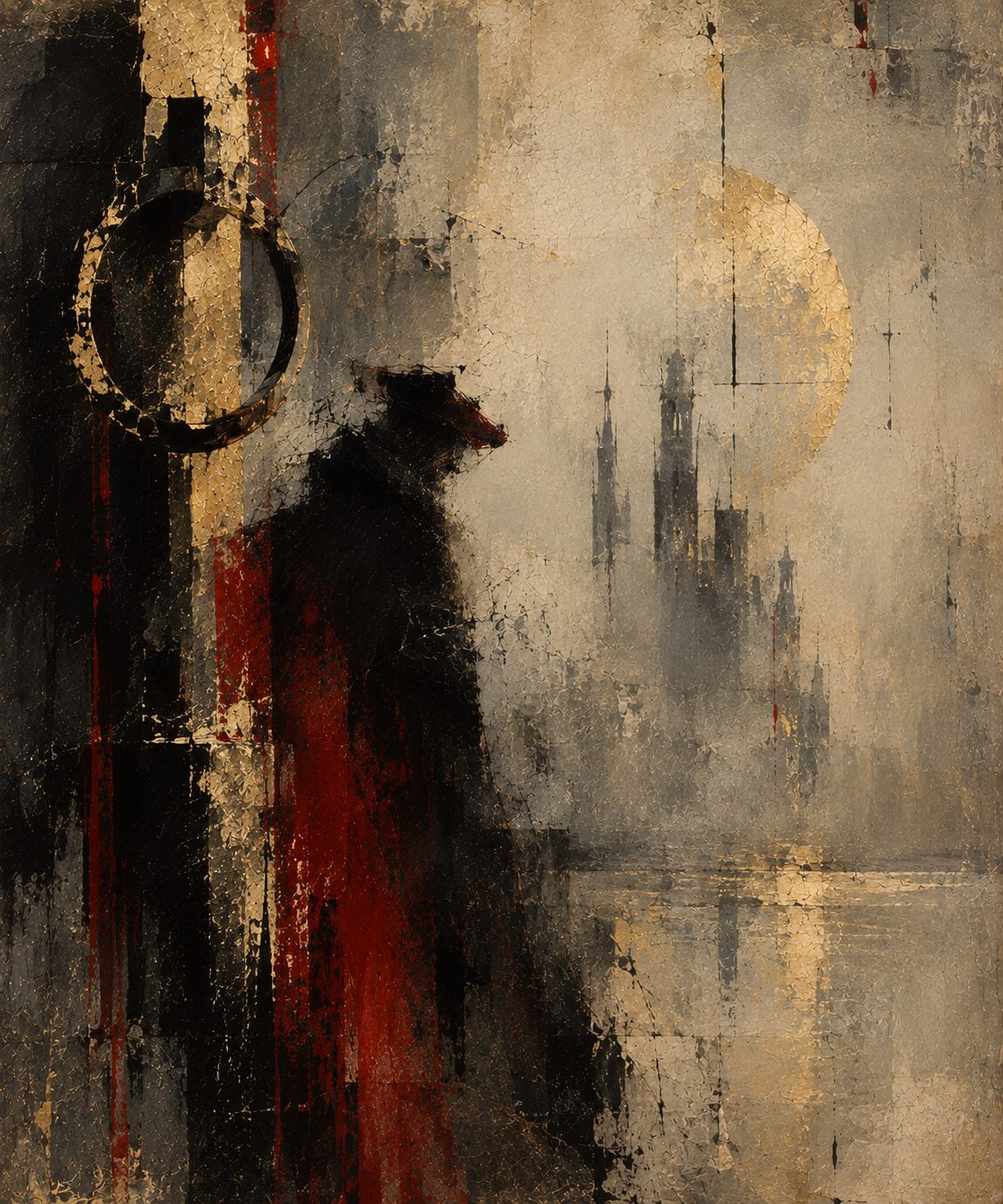
The false oath at the pillory
On Přemysl Otakar II Square in České Budějovice a pillory stood for two hundred years, and liars and perjurers were set by it. According to legend one morning a runaway horse dragged there a man who the day before had sworn a lie before the whole town council. It stopped exactly at that stone.
 Without embellishment
Hlavní verze je o soudu, o dívce a o dobrém jméně. Tahle je o posledních minutách jednoho muže a o tom, co při nich dělali sousedé.
- Legend
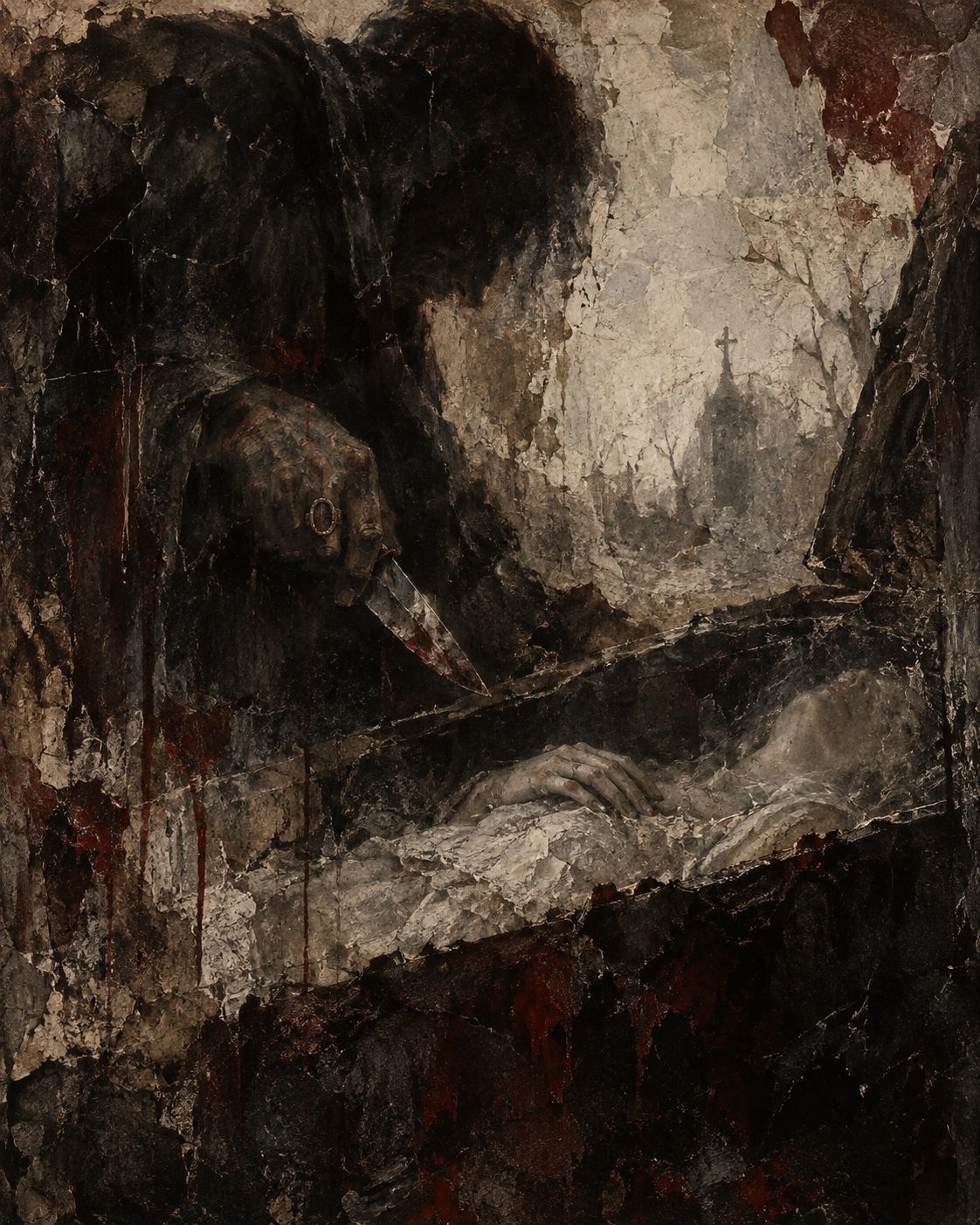
The House at the Dead Baker
At Krajinská třída no. 17 in České Budějovice stands a house once called At the Dead Baker. According to legend a baker’s only daughter was buried from there, and at night the gravedigger returned for the jewels given her for the last journey. The engagement ring held fast, so he drew a knife.
 Without embellishment
Hlavní verze končí tím, jak dům přišel ke svému jménu. Tahle zůstane s dívkou ve chvíli, kdy hrobař uteče a ona se probudí pod víkem.
- Legend
The nightmare (můra)
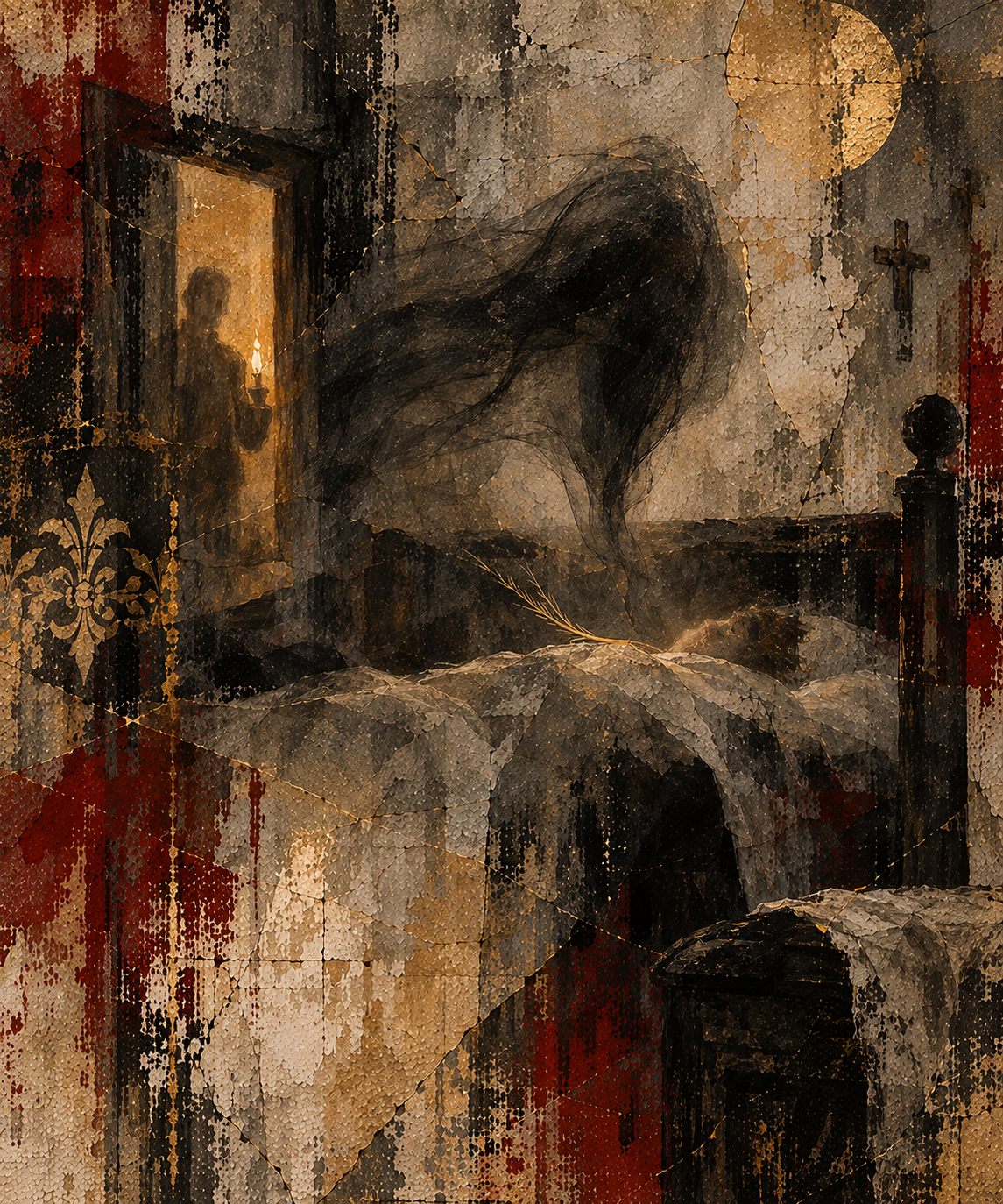
According to folk belief a můra was a living person whose soul left the body at night. It sat on sleepers’ chests, choked them and took small forms, such as a blade of straw. In Budějovice two stories were told of it: one of a cobbler and his journeyman, another of a miller’s lad.
 Without embellishment
Hlavní verze vypráví, co mistr našel na tovaryšově hrudi. Tahle zůstane v posteli s tovaryšem, který je vzhůru a nemůže se pohnout.
- Legend
The black dog
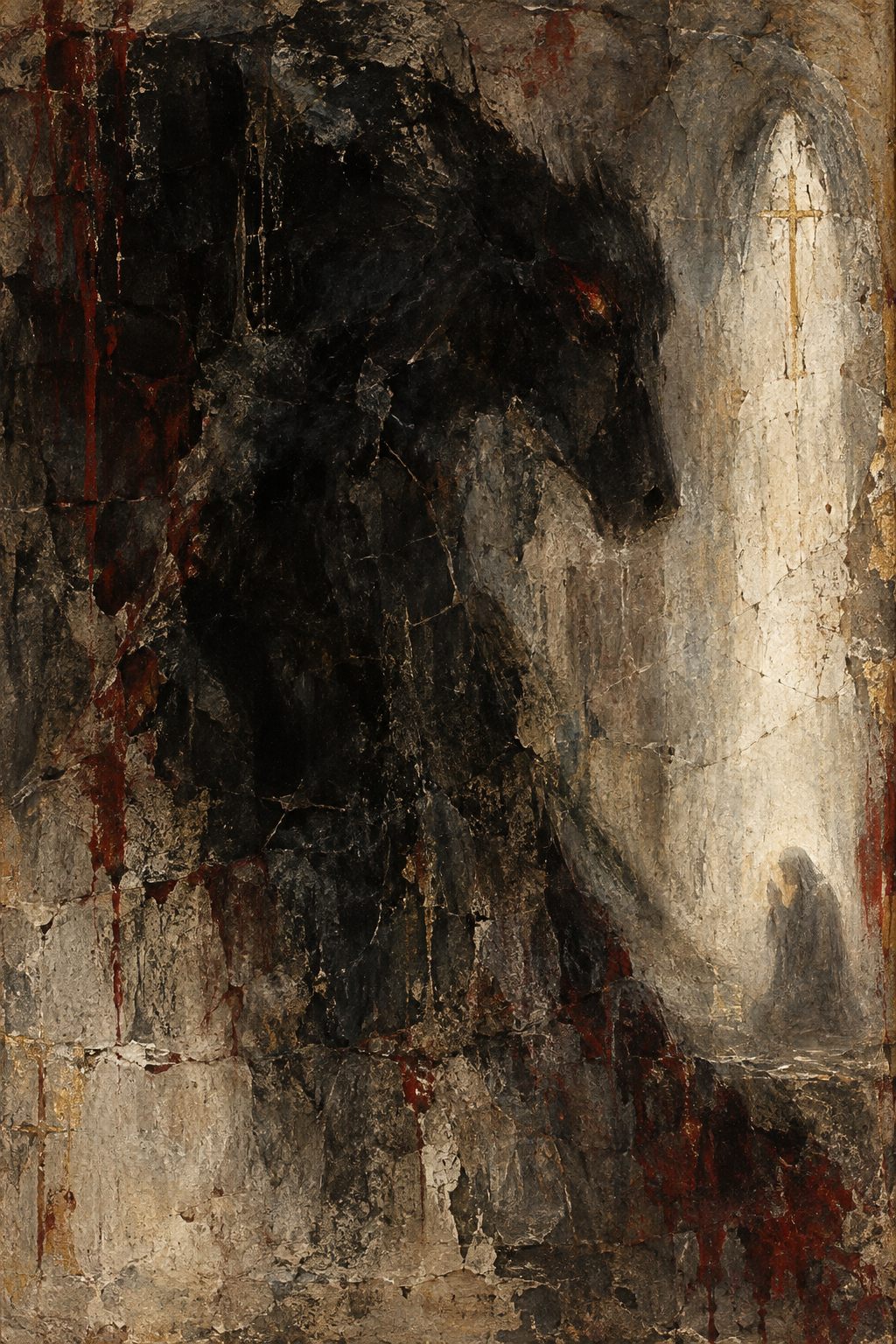
Between the Cathedral of St Nicholas and the deanery in České Budějovice there used to be a cemetery, and the shortest way from Kněžská street to the square led across it. One night a widow ran that way for medicine for her dying daughter. At the chapel a great black dog barred her path and laid its paws on her shoulders.
 Without embellishment
Obvykle se vypráví jako historka o strašidelném psovi. Tady jde o ženu, které doma umírá dcera a která neví, kolik času jí zbývá.
- Legend
There will be more of them
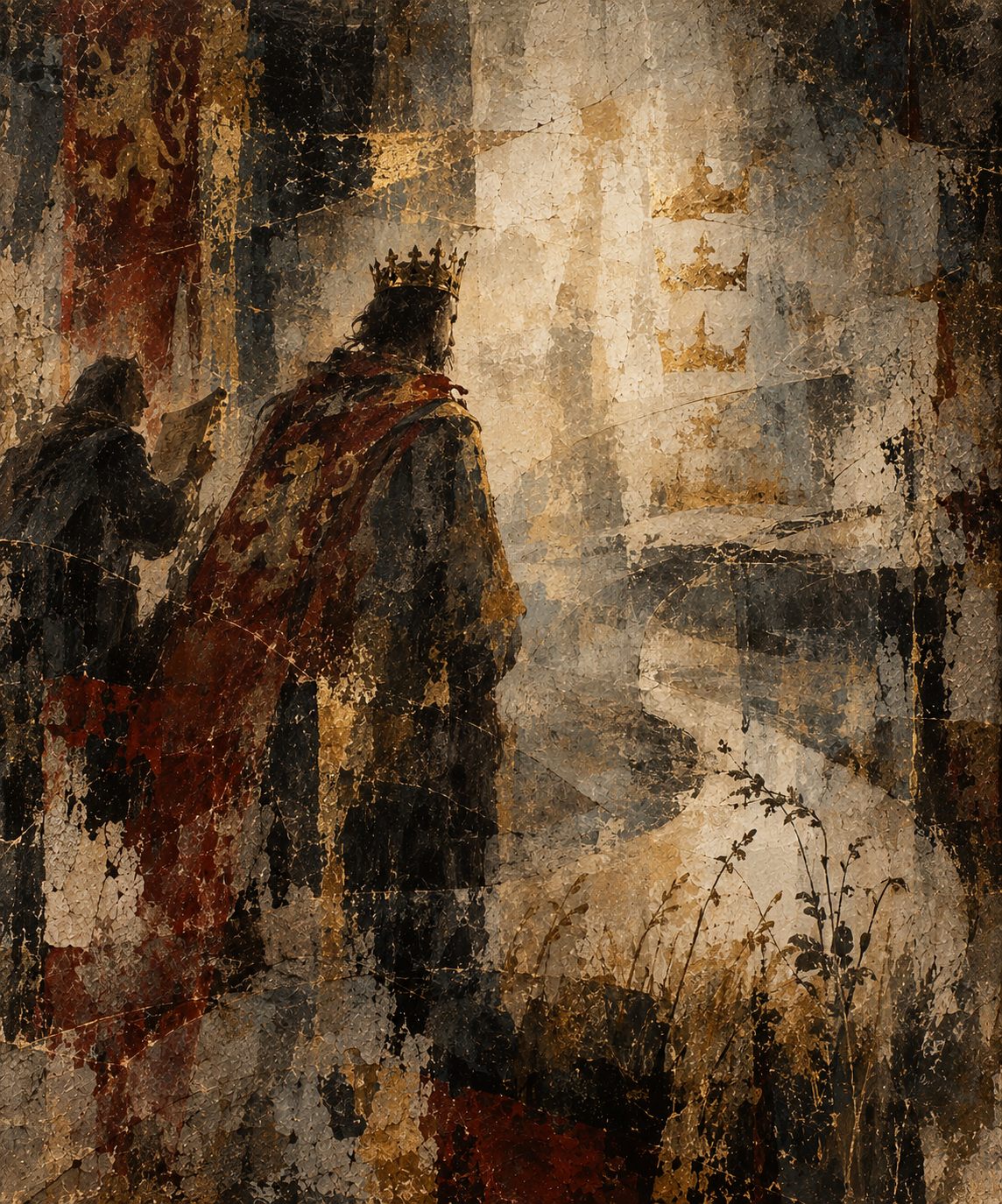
Přemysl Otakar II is said to have promised to found a monastery wherever news of a child’s birth reached him. A messenger caught him on a meadow between the Vltava and Malše, where nothing then stood. According to the legend the king cried three words from which the name of České Budějovice arose.
- Legend
The painting that stopped the Swedes and the plague
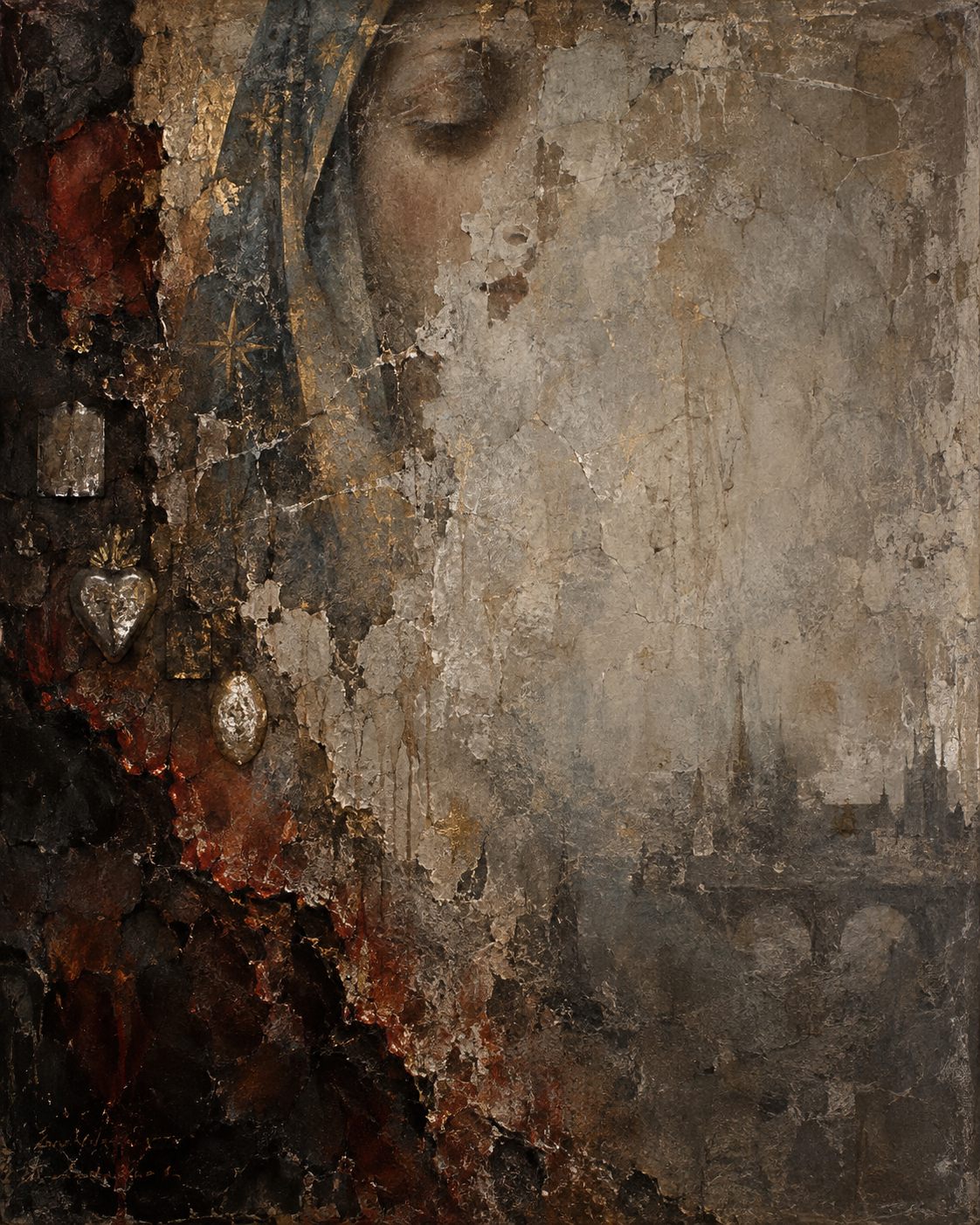
On the altar of the Church of the Presentation of the Virgin Mary on Piaristické náměstí in České Budějovice a painting of the Virgin Mary hung for centuries. According to legend it turned away the Swedes, stopped the plague and survived the great fire of 1641. It holds together a substantial part of Budějovice legends.


During your stay
Looking for tips for today?
Trips, days by mood, food and experiences are in the tips hub — separate from reading.